

In the intelligent transport systems (ITS) sector, the ultimate measure of success is not a headline-making emergency response – it is preventing an initial anomaly from escalating into a disaster.
From helping to prevent catastrophic fires in underground infrastructure to enabling municipalities to optimise complex intersections, Teledyne FLIR has become an established provider of transport-safety technology. Following its acquisition of traffic-technology pioneer Traficon, the company’s incident-detection technology – encompassing thermal imaging, video analytics and advanced detection systems – is now deployed in more than 4,000 tunnels worldwide.
In a recent interview with Zag Daily, Stefaan Pinck, Vice President of Global Business Development at Teledyne FLIR, outlined how advances in sensing and analytics are changing the way operators manage traffic, protect vulnerable road users and prepare for a connected and increasingly autonomous future.
The turning point in tunnel safety
The need for rapid incident detection inside tunnels was tragically demonstrated by the Mont Blanc tunnel fire in the late 1990s, which claimed 39 lives. The event became a catalyst for the industry, shifting the focus of video analytics towards automatic incident detection designed to prevent secondary accidents.
“The objective is not only to detect incidents but also to prevent secondary accidents,” explains Pinck. “If an incident is detected quickly, operators can close the tunnel, activate warning signs and alert approaching drivers before they enter a dangerous situation.”
Stopped vehicles, collisions and objects on the carriageway remain among the most common incidents monitored by operators. Pedestrians and vehicles travelling in the wrong direction present additional safety concerns, while fire detection remains one of the most critical applications.
For tunnel operators, thermal imaging can provide an earlier indication of developing heat sources, giving them more time to respond.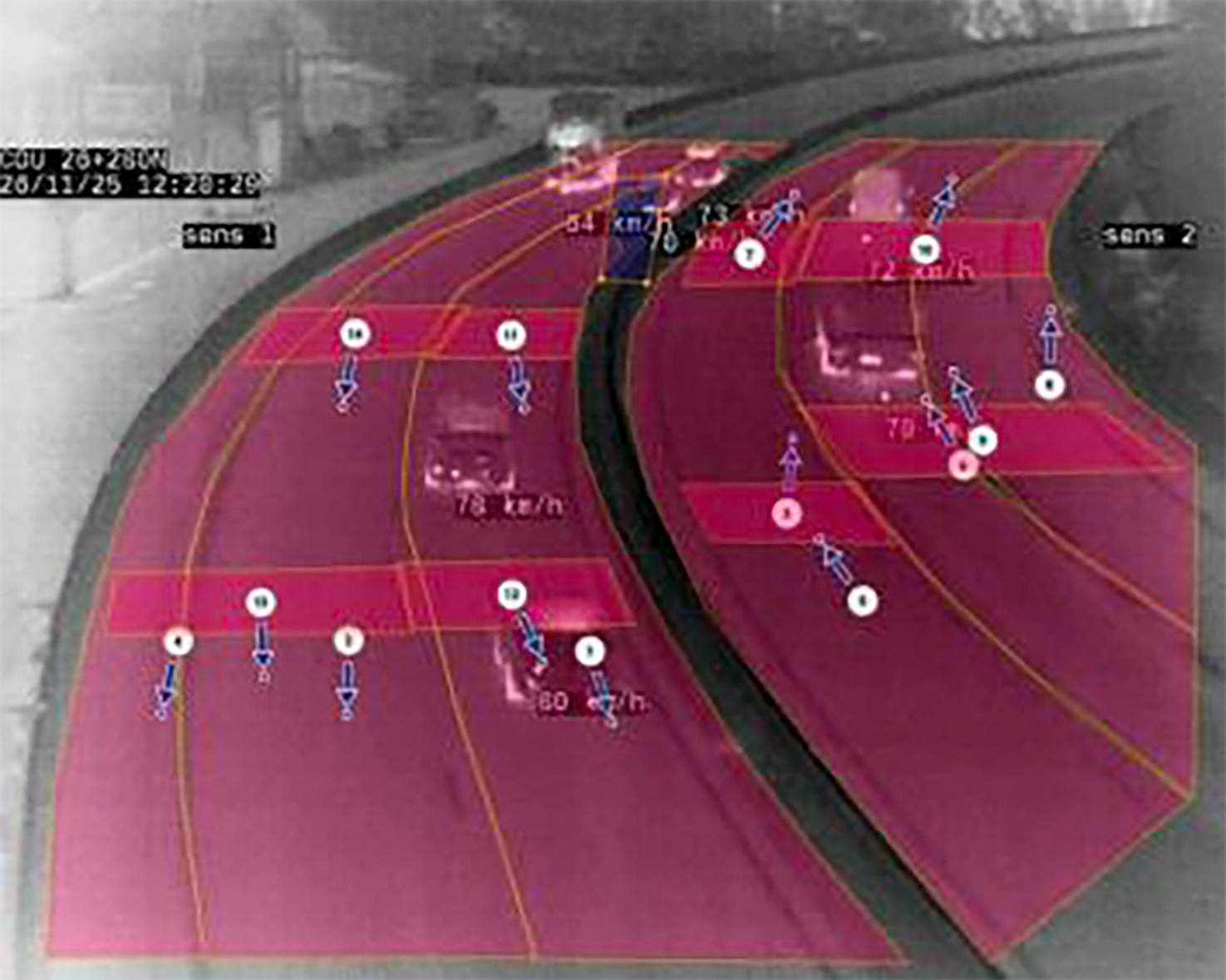
Why seconds matter in fire detection
In the harsh and enclosed environment of a tunnel, conventional cameras and traditional fire-detection systems can face significant limitations. Linear heat-detection systems may take several minutes to trigger an alarm, potentially allowing a fire to grow and cause serious structural damage before intervention begins.
Thermal imaging addresses some of these limitations by detecting the heat emitted by objects instead of relying solely on visible light. This allows thermal cameras to operate in total darkness and remain useful under challenging conditions involving glare or smoke.
“Our systems can typically detect a fire within 10 to 15 seconds,” Pinck notes.
Early detection gives operators a crucial opportunity to warn drivers, stop incoming traffic and deploy emergency services before conditions deteriorate.
Improving traffic management at intersections
Beyond underground environments, Teledyne FLIR’s analytics are being used to support above-ground traffic management. Originally utilised as an alternative to inductive loops for basic vehicle-presence detection, modern sensors can now generate detailed three-dimensional tracking data.
Current systems can classify and track the real-time position, speed and direction of pedestrians, cyclists, e-scooter riders, cars and heavy vehicles. This information allows traffic-signal controllers to make decisions based on the type and movement of each road user.
For example, an intelligent system could extend a green light to avoid unnecessarily stopping a heavy goods vehicle. This can improve traffic flow while reducing the additional fuel consumption and emissions associated with stopping and restarting large vehicles.
Protecting vulnerable road users
Poor weather, deep shadows and inconsistent street lighting can make pedestrians and cyclists difficult for drivers and visible-light cameras to detect. Under these conditions, thermal imaging can provide an additional source of environmental awareness.
As the industry moves towards vehicle-to-everything (V2X) communication, infrastructure-based sensing can provide an independent layer of protection. Connected vehicles may increasingly broadcast their positions, but vulnerable road users cannot be expected to carry connected devices or maintain charged mobile phones to ensure their safety.
“From a public policy perspective, safety systems must protect everyone, not only those who own specific devices,” Pinck told Zag Daily. “That is where infrastructure becomes essential. It acts as an independent source of environmental awareness.”
Designed for demanding environments
Because transport infrastructure presents demanding operating conditions, Teledyne FLIR develops both its hardware and analytics in-house. Its tunnel systems are ruggedised to withstand corrosive environments, water ingress and intensive cleaning regimes.
The company’s traffic sensors feature a compact, ball-shaped design. Originally conceived to be visually unobtrusive and reduce privacy concerns by avoiding the appearance of surveillance equipment, the shape also provides several practical operational benefits.
Its aerodynamic profile reduces wind loading during storms, while airflow helps keep the lens clean. The design also limits snow accumulation and makes it more difficult for spiders to build webs across the lens.
Whether deployed at a busy intersection or deep inside a mountain tunnel, the technology has a single purpose: identifying potential danger early enough for operators to take preventative action. In these environments, thermal imaging supports a broader approach based on proactive incident prevention.
“Success is measured by the tunnel incidents that don’t happen rather than the incidents that make headlines,” says Stefaan Pinck.


