

The new digital Structural Health Monitoring system (SHM) from Kistler is now in live operation on a prestressed reinforced concrete rigid-frame bridge in Winterthur, Switzerland. First presented at Intertraffic 2026, the installation shows what fully digital continuous monitoring looks like under operational conditions: microsecond synchronization across all sensors, a plug-and-play setup and minimal cabling shows a drastical reduction in installation complexity. The site is now open for individual visits, offering infrastructure professionals, bridge engineers, and asset owners the opportunity to see live bridge condition monitoring and discuss their own projects on-site.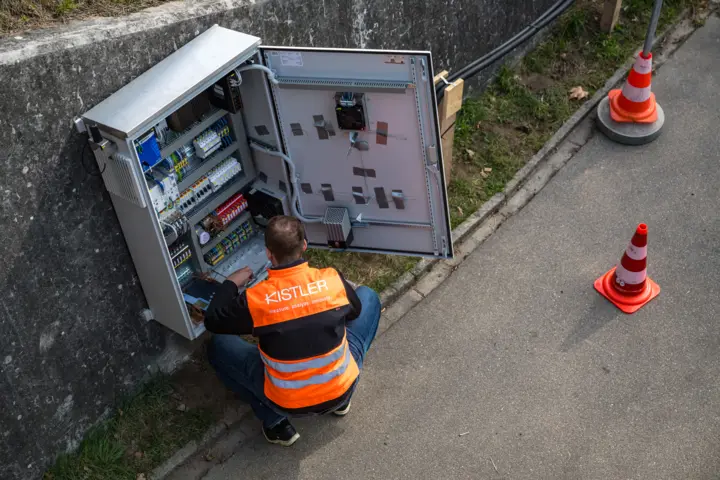
Structural Health Monitoring has traditionally relied on centralised analogue architectures with extensive cabling and complex signal chains. By digitalizing data directly at the sensor, Kistler takes a fully digital approach that improves data quality and enables real-time monitoring.
The bridge is part of an exceptional heavy load transport route. This implies that the bridge must accommodate extremely demanding loading scenarios: gross vehicle weights of up to 480 tons and axle loads reaching 30 tons are possible. This demanding environment makes it an ideal application for continuous Structural Health Monitoring. Kistler has deployed the fully digital SHM system both as a permanent real-world Structural Health Monitoring and as a live demonstration platform for customers and partners, capturing structural response and environmental influences under real operating conditions.
The digital sensor chain for bridge monitoring in practice: simplest installation and highest data quality
At the core of the installation is the digital sensor chain, an architecture in which signal acquisition and digitalisation occur directly at each sensor. This eliminates the need for traditional, centralised data acquisition units and ensures data integrity across the entire measurement chain. Data and power travel through a single cable in a daisy-chain topology. In combination with the plug-and-play setup, this makes deployment faster, less invasive, and significantly more cost-efficient.
Every sensor in the network is synchronised at the microsecond level – a fundamental requirement for dynamic structural analysis. This enables engineers to detect subtle changes in structural behaviour and identify mode shapes with confidence. Unlike analogue systems, the fully digital architecture eliminates electromagnetic interference and signal degradation, ensuring consistent data quality throughout the service life of the monitoring system.
Comprehensive continuous condition monitoring – with sensor network covering all parameters
The installed sensor network covers the full range of parameters relevant to real-time bridge condition monitoring. Triaxial EasySense accelerometers (with very low noise density of 25 µg/√Hz) capture global dynamic behaviour, including bending and torsional responses under traffic and wind loads. Alongside them, triaxial UltraSense accelerometers (with an ultra-low noise floor of 0.7 µg/√Hz) resolve low-amplitude vibrations in structurally very stiff components.
Crack meters track openings at critical locations. Triaxial inclination sensors at the supports measure rotational behaviour, while strain sensors provide continuous stress evaluations from bending moments. Temperature sensors and a weather station provide the environmental context essential for accurate deformation and displacement monitoring over time.
The combination of these measurements makes the sensor network particularly powerful. By continuously and synchronously capturing structural response, environmental influences and dynamic excitation, it provides engineers with a complete, correlated dataset for meaningful structural health assessment.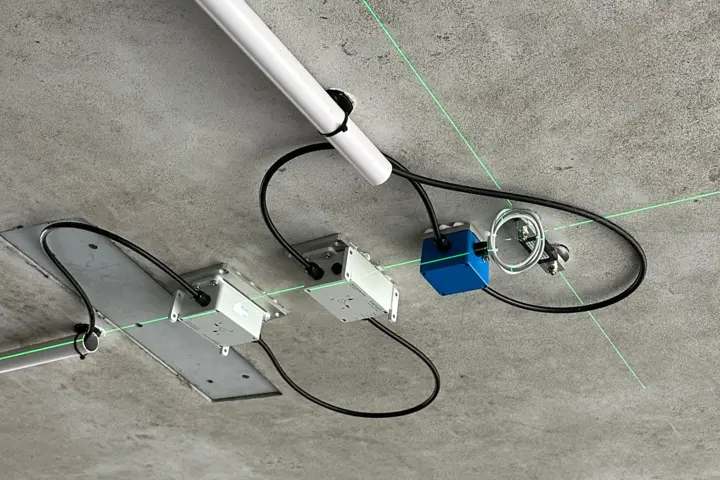
Reliable, scalable Structural Health Monitoring solution featuring plug-and-play setup
All sensors are factory-preconfigured and support auto-configuration during deployment, eliminating manual settings and reducing installation errors. In Winterthur, mounting was carried out using glued techniques, proven to be efficient and reliable for this type of structure. The Structural Health Monitoring system also supports screw, magnetic, and welded solutions, making it adaptable to virtually any bridge type or structural configuration. Due to its modular architecture, the system can be extended or reconfigured as monitoring requirements evolve, supporting long-term predictive maintenance without replacing existing infrastructure. The result is a structural health monitoring system that is as practical to deploy in the field as it is powerful in operation.
Continuous bridge condition monitoring – live and on-site in Winterthur
The Structural Health Monitoring system installation was realised in close collaboration with the City of Winterthur’s Civil Engineering Office (Tiefbauamt) and the Head of the Civil Engineering Office Martin Joos. As a live demonstration site, the monitored bridge allows infrastructure professionals, bridge engineers and asset owners to experience a fully digital bridge health monitoring system under real operating conditions. During individually arranged site visits, Kistler experts provide insights into the installation and discuss their specific monitoring requirements.


