
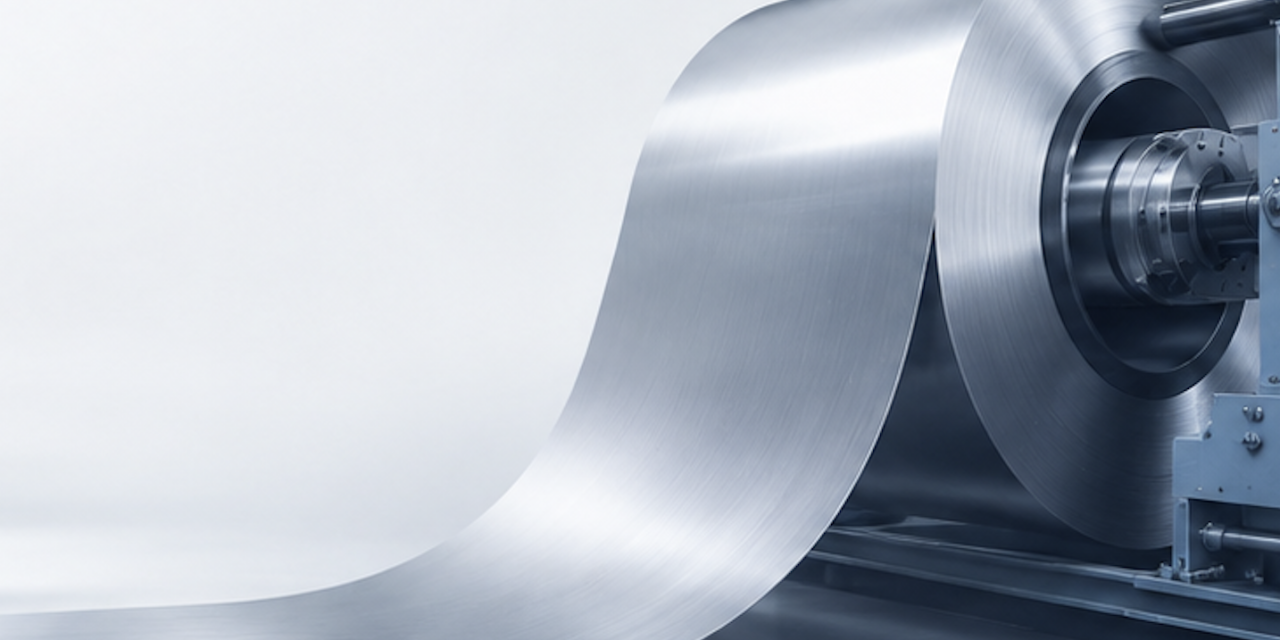
From EV batteries to solar cells, medical devices and aerospace components, everyday life is increasingly dependent on ultra-thin metal foils that feature in thousands of electrical and electronic devices and systems. ABB’s Marko Sydänlammi, Global Portfolio Manager – Flatness systems, explains the challenges in high grade foil production, and the importance of accurate force measurement to ensure precise control of metal foil flatness and thickness.
Ultra-thin metal foils play a fundamental role in enabling our global energy transition. They are an essential component in rechargeable lithium-ion batteries that supply power for electric vehicles and countless electronic devices for industrial, medical, scientific and consumer applications. They’re also employed in the design of solar cells and energy storage systems, and to shield sensitive components and systems from electromagnetic interference. Aside from their use in electronics and energy, metal foils feature widely in other applications from packaging and insulation to catalytic converters for automobiles.
Demand for thinner foils, higher quality and better yields
Anticipated to reach over $3 billion by 2033, the global market for ultra-thin foils, including copper, aluminium, stainless steel and other metals, is growing steadily. As demand increases, manufacturers are under pressure to maintain their competitive edge by ensuring the consistent performance of their products. In particular, customers’ desire for smaller, lighter, and more efficient electronic devices puts pressure on metal foil producers to deliver thinner materials with tighter tolerances that may be as small as just a few fractions of a micron.
When it comes to thickness measurement, the real question is how thin is thin? More substantial foils used for industrial applications like insulation, aerospace and automotive manufacture can measure from 100 to 200 microns, or millionths of a meter. Conversely, the foils used in batteries, integrated circuits, packaging, capacitors and other electronics devices can measure down to a gossamer-thin 5 microns, right at the limits of visibility to the unaided human eye.
The manufacture of ultra-thin and speciality metal foils demands exceptionally precise control during the multi-stage rolling process. Any departures from uniform thickness, flatness or surface quality of copper and aluminium foils used as electrodes in lithium-ion batteries, for example, can mean compromising battery efficiency, lifespan and safety.
Measurement to the micron
Maintaining product quality is achieved in modern rolling mills with force sensors that enable real-time control of key rolling parameters such as speed, flatness, thickness and tension. By providing stable and accurate data, these sensing systems enable metal manufacturers to make fine adjustments that ensure high-grade foils are produced to within strict tolerance limits.
Rolling ultra-thin metals and foils with the required standards of accuracy and consistency for today’s demanding applications presents some unique challenges. In particular, it’s a process that requires the use of highly sensitive measurement devices that can detect subtle force variations.
Precise control is essential to achieve the required material properties. Given their delicate nature, even minor fluctuations in pressure and tension can alter the curvature, mechanical stiffness or electrical conductivity of ultra-thin metal or foil sheets. It’s vital to ensure that flatness is maintained throughout rolling to avoid defects such as edge wave or center buckle that can occur during processing. Any anomalies increase the risk of strip breakage which can cause further production losses.
To address these constraints, low-force measurement solutions must deliver high sensitivity and long-term stability within a compact, robust design that can deliver continuously reliable performance and avoid disruption to production. This can be problematic with the standard force sensing systems that are widely used for cold rolling processes in the metals industry. These technologies may lack the resolution or stability needed for highly specialised applications such as ultra-thin foil manufacture. Equally, they can suffer from other practical and commercial disadvantages that limit their appeal to high-grade foil producers.
Piezoelectric sensors, for example, have been the industry standard for dynamic measurement of pressure, force and acceleration for decades.
While they offer numerous benefits, these types of sensors also have disadvantages that can impact on their performance. Their non-parallel mounting arrangement, for example, increases their sensitivity to tension variations and results in slower and less accurate automatic flatness control (AFC) as the measurements need to be heavily filtered.
Piezoelectric systems also typically allow only one sensor per zone, leading to a measurement density that is four times lower than that of ABB’s Stressometer®, reducing overall precision and responsiveness. Furthermore, unlike Stressometer technology which automatically compensates for external disturbances, piezoelectric sensors must correct for these factors via software, which is inherently less accurate.
The construction of piezoelectric sensors also poses issues, as the ceramic sensing element is housed in a metal body, which expands or contracts with temperature changes while the sensor element remains largely unaffected. This mismatch can introduce further errors unless meticulously compensated for, adding complexity and reducing performance.
By contrast, air bearing sensors rely on rings riding or rotating on a cushion of pressurized air for measurement of differential pressure. While they provide good measurement performance, their reliance on compressed air and associated infrastructure can affect system design and maintenance planning, as well as increasing energy costs.
A challenging environment for force sensing systems
Like a fragile sheet of tissue paper, ultra-thin foils are vulnerable to small changes in tension or pressure as they’re subjected to multiple rolling passes. Breakage of the delicate metal strip due to microscopic material defects will bring production to an abrupt standstill or cause significant product quality deterioration. Even the smallest deviations from tightly specified foil parameters means line stops and lost production time, plus profit-sapping wastage of rejected material or re-processing.
Further challenges are also often introduced by environmental conditions at the rolling plant. Temperature variations and mechanical vibrations can cause drift in the sensors used to measure roll thickness and tension, progressively undermining measurement accuracy. Typically, this is addressed by regular sensor recalibration – a labor-intensive task that inevitably means more process downtime – or software compensation and filtering of electrical signals. Added to these challenges is the limited installation space in modern rolling mills, which restricts the use of large or complex sensor assemblies.
To address these issues, accurate low-force sensing is a critical enabler for precise monitoring and control of foil flatness and thickness. Even the smallest material inconsistency or defects can have abrupt and often costly consequences, placing even greater importance on the reliability and accuracy of the force measurement and control system.
Specialised low-force solution meets the demands of ultra-thin foil production
Reliable and repeatable measurement is made easier with the use of specialised low-force sensors that can detect extremely small variations in rolling force and/or strip tension to within a few grams. By capturing high-resolution force data in real time, modern sensing systems enable immediate correction of rolling parameters. With the latest solutions such as ABB’s next-generation low-force system, for example, it’s possible to achieve unprecedented control of thickness and flatness control in finishing applications handling foil gauges ranging from 50 down to 5 microns where standard systems based on piezo-electric or air-bearing technology can suffer from noise or drift.
Featuring proven Pressductor technology, ABB’s Stressometer Low-Force System is an effectively maintenance-free solution that’s immune to process and ambient variation of parameters like strip tension and temperature. With no need for regular recalibration, the system can operate for extended periods with little or no intervention, further contributing to optimised yields and reduced ownership costs.
Achieving consistent quality and greater profitability
By enabling tighter and more confident control of cold rolling processes, today’s low-force sensing solutions allow ultra-thin and speciality metal foil producers to ensure their products consistently meet the requirements of a competitive global market for high-performance electronic devices and other applications.
Accurate, consistent force measurement in the micron range during cold rolling supports product quality and production efficiency, reducing defect rates and optimising throughput by reducing costly stoppages caused by the breakage of delicate foils. Using the latest-generation sensing and control solutions also afford metal producers the opportunity boost their profitability, with reduced manual labour overheads and greater energy efficiency compared with conventional low-force measurement solutions.
To learn more, visit https://new.abb.com/products/measurement-products/flatness-measurement/measuring-roll/low-force-system.


