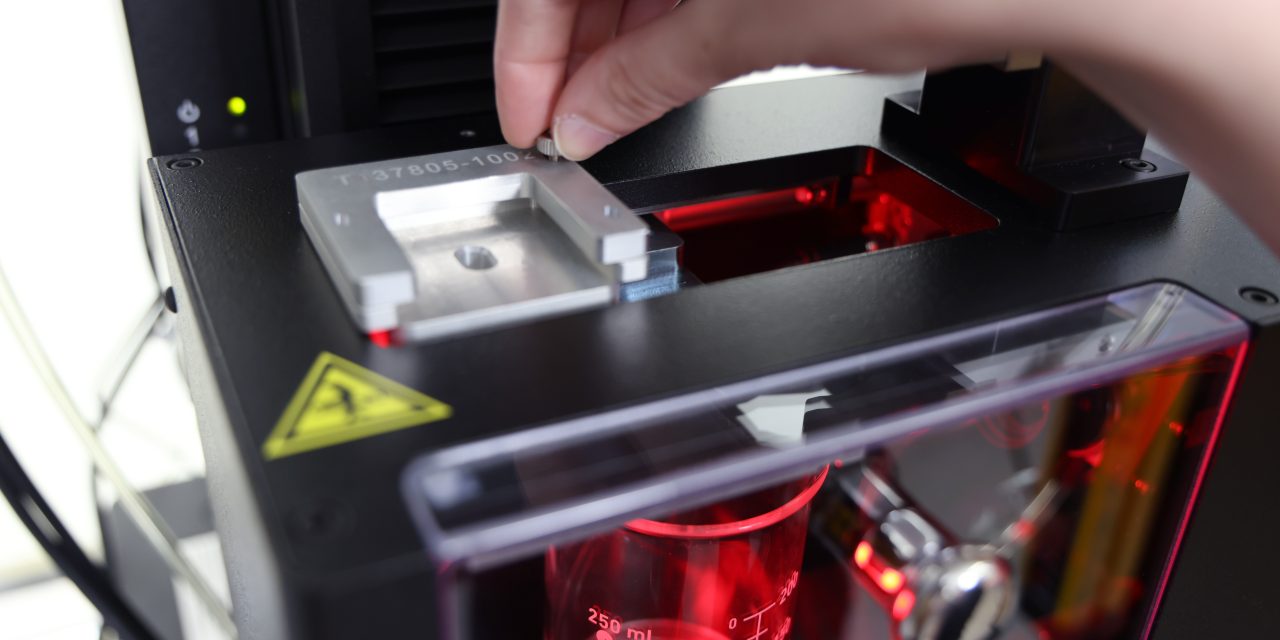
For many patients receiving biologic therapies, treatment has traditionally meant travelling to a clinic for an intravenous infusion. But the development of large-volume autoinjectors allows more of these therapies to be self-administered at home. Here, Meredith Bernstein, Biomedical Product Manager at mechanical testing specialist Instron, explores how increasing drug volumes are creating new considerations for device testing.
The shift towards higher-volume autoinjectors is already visible in the market. In October 2026, the US Food and Drug Administration (FDA) approved a new two millimetre autoinjector for LEO Pharma’s Adbry, a biologic treatment for moderate-to-severe eczema. Previously, patients receiving a 300 mg dose required two separate one millimetre injections.
The new device delivers the same dose in a single injection, reducing the number of injections required. While this represents an improvement in convenience for patients, delivering larger volumes through a single device also places greater demands on autoinjector performance, particularly when it comes to injection force, delivery time and dose consistency.
As more therapies are adapted for self-administration, manufacturers must balance the convenience of fewer injections with the technical challenges of delivering larger drug volumes safely and consistently. This is placing new demands on autoinjector design and, crucially, how these devices are tested.
More volume, more variables
Many biologic therapies are high-viscosity formulations that require larger doses than conventional autoinjectors were designed to accommodate. Conventional autoinjectors have a capacity between one or 2.25 millilitres (ml) of pharmaceutical product, while large-volume devices generally start at around three ml. Devices currently being evaluated by major pharmaceutical companies reach 5.5 ml, with platforms capable of delivering as much as ten ml under development.
However, increasing the volume of drug inside an autoinjector is not simply a matter of making the existing device larger.
Increased fluid volumes and higher viscosities affect everything from the mechanism driving the injection to the size and design of the primary container. Device manufacturers therefore need to understand how the complete system behaves before it reaches the patient.
Understanding the fundamentals
Regardless of volume, autoinjector testing must assess fundamental aspects of device performance. For example, some larger autoinjectors use a cartridge rather than a prefilled syringe as their primary container, and certain cartridge-based designs require the user to twist the cap before injection to engage the needle and establish the fluid path.
Testing this action therefore requires more than a conventional linear force measurement as it must reproduce and measure rotational and linear movements, requiring biaxial testing capability. This can be added to a compatible testing system through a Torsion Add-On, enabling both axial and torsional loading to replicate the combined forces experienced by the device during use.
The way a device communicates with its user may also differ. Many conventional autoinjectors produce audible clicks to indicate that injection has started or finished. Some large-volume designs instead produce a continuous sound during delivery, with the end of that sound signalling completion.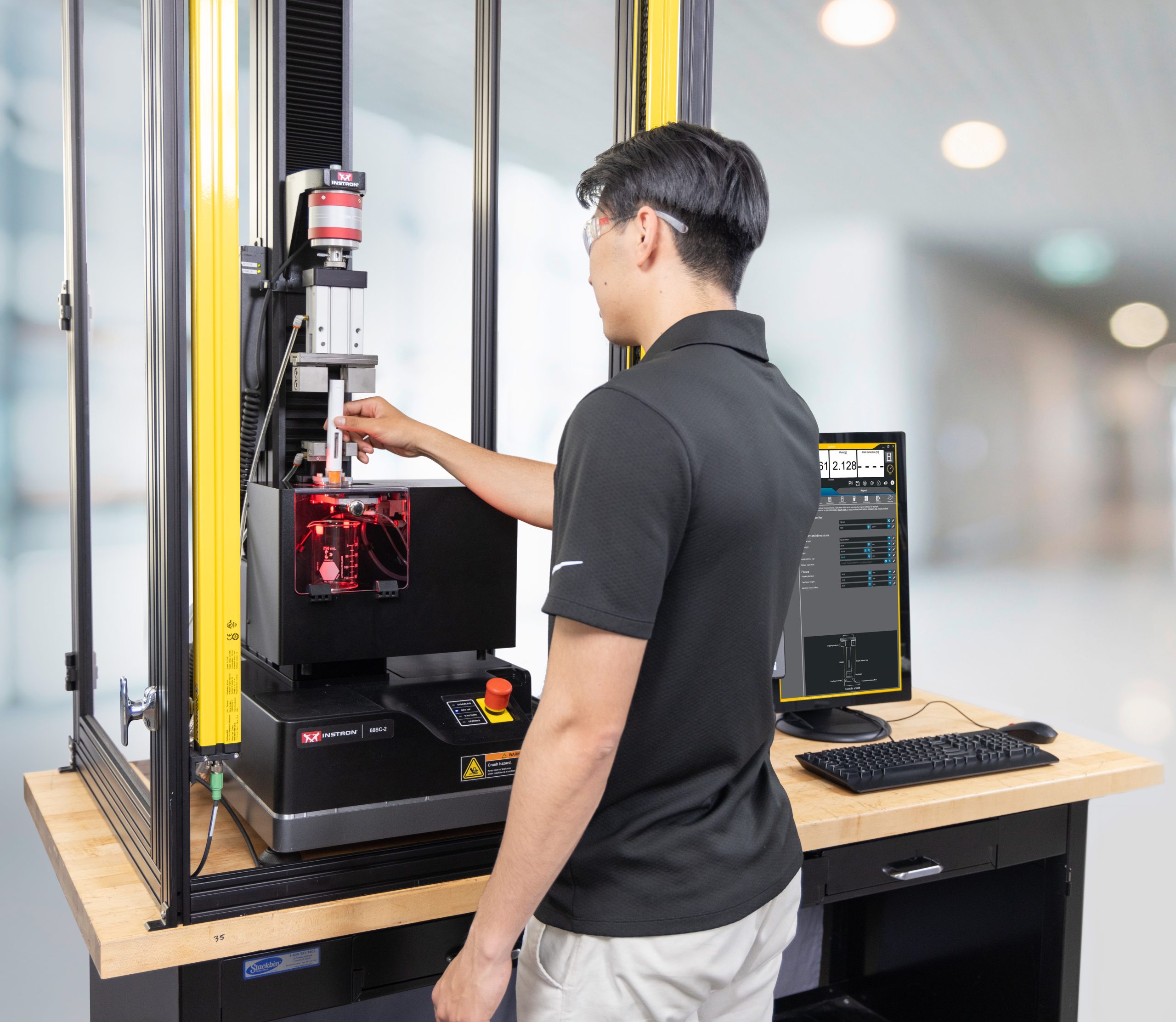
Capturing audio alongside force, delivered volume and other test data therefore provide a more complete picture of how the device will behave for the patient.
The number of variables involved presents a practical challenge for testing laboratories. Individual performance characteristics may require separate equipment or test procedures, which means more specimens, more equipment and data generated across multiple tests that must subsequently be consolidated.
Instron developed its Autoinjector Testing System to bring these measurements onto one platform. Rather than moving a device between separate test stations, laboratories perform a sequence of functionality tests on the same system. This approach reduces the number of devices required for testing while simplifying data consolidation, analysis and validation. In turn, laboratories can reduce the time and resources associated with the testing phase, helping to control testing costs while improving overall efficiency.
This becomes particularly important as manufacturers move from development towards production. The system’s Bluehill Universal software allows users to start from a pre-loaded template for two-step or three-step autoinjectors, as well as safety syringe devices, and customize as needed by selecting the required functional tests and defining their parameters. Parameters can then continue to be modified as new device requirements emerge.
This flexibility matters in a field where device design is still evolving. Fixtures accommodate different device geometries and new inserts can be created for future designs, rather than requiring an entirely new testing platform each time the format changes.
Treat the cause, not the symptom
Repeatability is particularly important because an unexpected result does not necessarily mean the device itself has failed.
If an injection time, needle depth or delivered volume falls outside the expected range, engineers need enough information to understand why. Integration of a high-resolution video recording of the injection is essential here, so that engineers can perform their post-test analysis and distinguish what behaviour may have caused the abnormal result.
This becomes increasingly valuable as testing moves into production environments, where an unexplained deviation can delay product release while root-cause analysis is completed.
For testing laboratories, the answer doesn’t simply lie in equipment capable of accommodating a physically larger autoinjector. The testing approach also needs to reproduce how the device is used, capture multiple performance characteristics and remain adaptable as new formats emerge. Large-volume autoinjectors are expanding what is possible for subcutaneous drug delivery, but they also broaden what manufacturers need to consider during device testing.
Learn more about autoinjector testing systems for therapies from Instron, and download our brochure, by visiting the website.
Read other recent instrumentation news: https://instrumentation.co.uk/category/news/