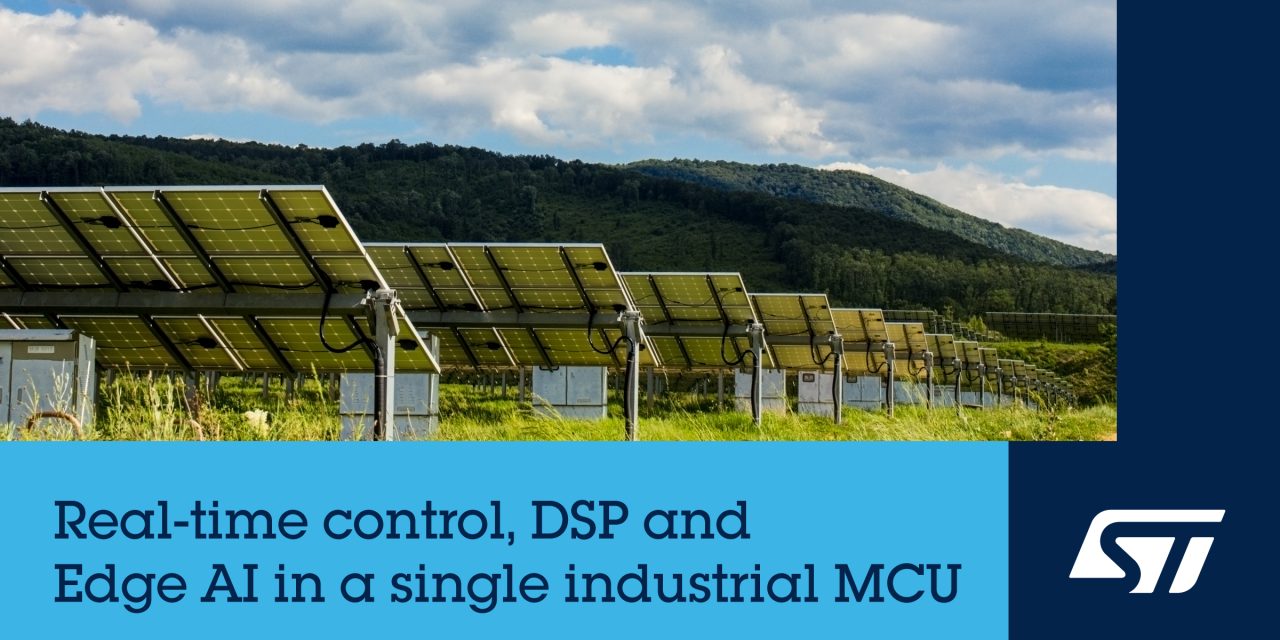
STMicroelectronics’ STM32H7P microcontrollers combine hardware acceleration for DSP and edge AI workloads with an Arm Cortex-M7 core rated at 2,773 CoreMark. The devices are designed for digital power, motor control, condition monitoring and other mission-critical industrial applications.
Hardware acceleration for DSP and edge AI
The architecture includes ST’s Hardware Signal Processor (HSP) and Neural-ART neural processing unit (NPU). The HSP is a cost-optimised, energy-efficient DSP accelerator for matrix, vector and digital signal processing operations. By offloading these workloads from the main CPU, the HSP frees up Cortex-M7 bandwidth and can reduce the need for a dedicated external DSP. It performs fast Fourier transforms (FFTs) up to five times as fast as a software implementation on the Cortex-M7.
“The STM32H7P extends the proven STM32H7 series, with two dedicated hardware accelerators alongside a 520 MHz Cortex-M7 core that deliver 1.7 times the performance of alternative products on the market. Combining more real-time performance with advanced hardware acceleration for DSP and edge AI, these MCUs let engineers build the next generation of smart, responsive embedded systems across industrial, power electronics, sensing and intelligent edge applications,” said Laurent Vera, STM32 marketing director at STMicroelectronics. “In addition, richer analogue and timer capabilities and strong cost efficiency are ideal for power electronics applications such as solar, digital power and motor control.”
The new MCUs feature larger tightly coupled memories (TCM) for fast access to instructions and data, improving performance in real-time control, signal processing and AI inference.
The series offers up to 2 MB of flash memory for non-volatile code and data storage, at a price similar to that of the previous 1 MB STM32H7 series. This gives general-purpose and mass-market designs more real-time performance and greater memory density without moving to a higher-cost platform.
The STM32H7P also features advanced analogue peripherals, including ADCs, DACs and comparators, as well as timers inherited from the STM32G5 mixed-signal series, supporting industrial control applications.
The Neural-ART NPU improves the efficiency of edge AI workloads and supports larger, more complex networks. It delivers up to 85 GOPS. Compared with software execution, ST reports up to 40 times faster inference for its AI arc fault circuit interrupter (AFCI) model for solar inverter safety, 20 times faster inference for its anomaly detection model and 15 times faster inference for its AI battery management system (BMS) model.
Development tools and availability
ST Edge AI Suite provides case studies, tools and resources for developing and deploying embedded machine learning models on STM32 devices. Developers can also use DSP enablement software and ST’s X-CUBE-MCSDK-2 motor control tools.
The STM32H7P will also work with the upgraded STM32Cube ecosystem, including the enhanced STM32CubeMX2 configurator and HAL2, the latest hardware abstraction layer optimised for code size.
The STM32H7P MCUs operate at ambient temperatures of up to 125 °C and are included in ST’s industrial longevity support programme. An exposed-pad LQFP package option improves heat dissipation for high-temperature industrial designs.
The STM32H7P series is now sampling with OEMs, with production planned for January 2027. Pricing starts at $4.43 for a device with 1 MB of flash memory in an LQFP100 package, based on orders of 10,000 units. The NUCLEO-H7P5II evaluation board and STM32H7P5IDK Discovery kit will also be available in January 2027.
For more information, visit the STM32H7P product page.
Read other recent instrumentation news: https://instrumentation.co.uk/category/news/