

Fluke recently announced the release of the Fluke FEV500, an all-in-one testing solution designed specifically for fast DC Level 3 EV charging stations, adding to the company’s already extensive EV offerings. The new tool enables technicians in the field to quickly perform comprehensive safety and operability tests on-site without the cost, complexity, or uncertainty of using an actual EV. Taking this approach ensures charging stations remain safe, reliable, and fully operational during the testing process. Instrumentation Monthly caught up with Fluke to find out more about the product…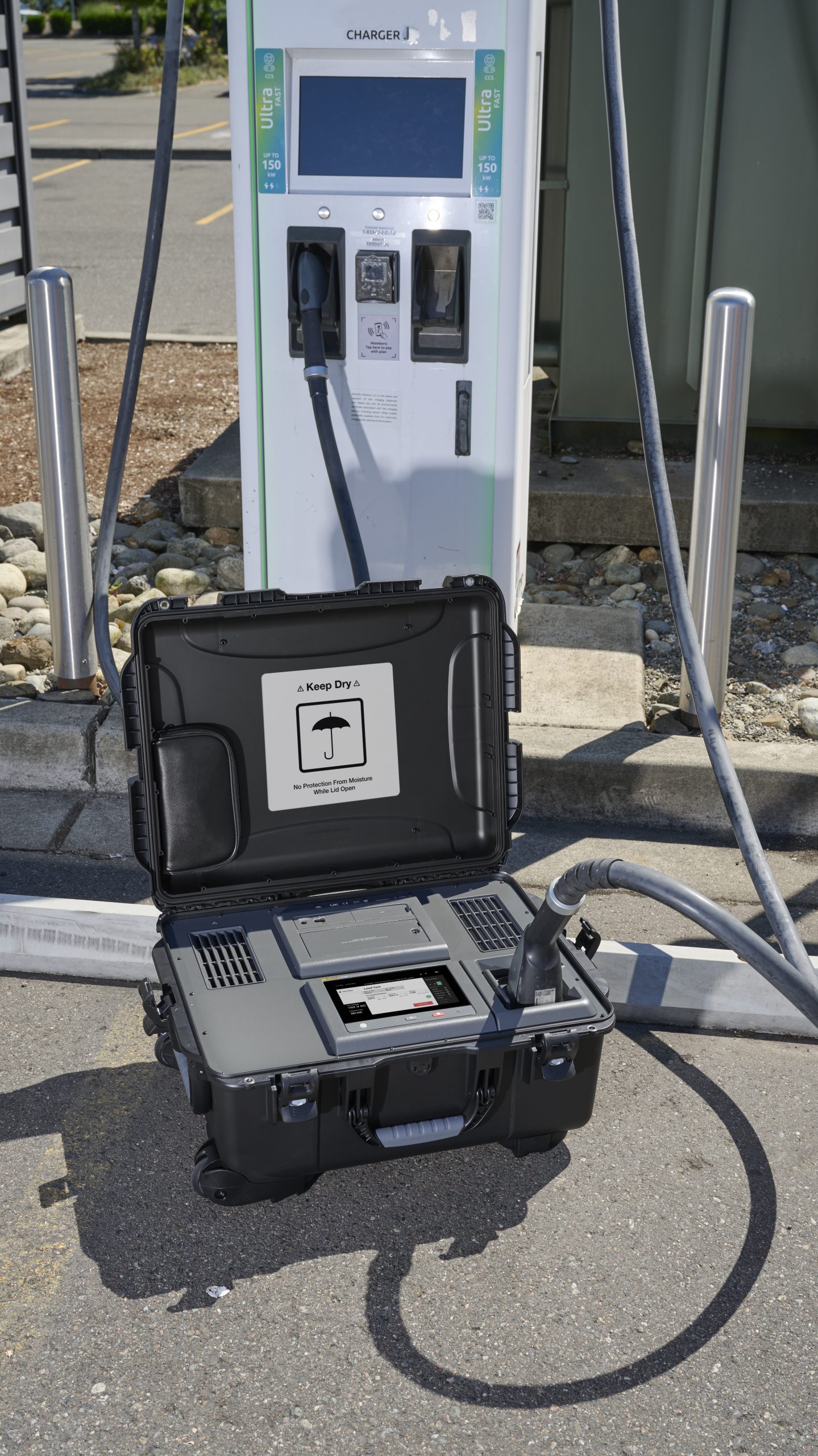
Q: Can you introduce the FEV500 and explain the role it plays in testing and maintaining fast DC EV charging stations?
The FEV500 is all-in-one testing solution designed specifically for fast DC Level 3 EV charging stations which operate at high power levels, depending on complex communication protocols. The solution plays a vital role in maintaining safety, reliability, and uptime – all critical concerns for operators.
Capable of acting as a virtual vehicle, the FEV500 enables technicians to quickly perform comprehensive safety and operability tests on-site without the need for a real EV. Combining a range of tools and functions into a single device not only offsets the cost, complexity, or uncertainty of using an actual EV, it simplifies troubleshooting and helps operators minimise downtime with ensuring charging stations remain fully operational.
Q: What challenges do technicians typically face when testing high-power DC charging infrastructure, and how does the FEV500 address them?
Technicians testing high-power DC charging infrastructure face several challenges, including high failure rates, complex communication protocols and the need to use multiple specialist tools. Over a quarter of public EV charging attempts in some European regions fail, even when stations appear to be online. With this in mind, improving testing efficiency has never been more critical.
The FEV500 makes testing more efficient by acting as a virtual EV, replacing the need for multiple tools while providing technicians with guided instructions on critical testing criteria.
The tool’s intuitive auto-test feature receives data directly, removing the need for manual input.
The product offers a portable solution that enables technicians to conduct all tests through a single connection point, with no disassembly required. This means troubleshooting can take place without opening the charging station, avoiding costly downtime.
Q: The FEV500 replaces several traditional test instruments. What measurements and diagnostics can technicians perform using the device?
The FEV500 replaces traditional tools such as the digital multi-meter, insulation testers, and oscilloscopes by consolidating key measurements and diagnostics into a single device. Technicians can perform comprehensive safety and performance testing on DC charging stations, treating the tool as a virtual EV.
Combining performance, interoperability, and safety checks in a single device, the tool is designed to meet ISO 15118 and DIN SPEC70121 international standards for digital communication between electric vehicles and electric vehicle supply equipment.
Q: How does the guided workflow and PASS/FAIL testing approach simplify testing for field technicians?
Testing is simplified through guided workflows that provide clear, step-by-step instructions on critical testing criteria. The FEV500 offers automated testing, with PASS/FAIL results allowing users to quickly determine whether a station meets the required safety and performance standards without needing to interpret complex data. This reduces the need for advanced training while providing actionable data for regulatory compliance, maintenance planning, and performance forecasting.
As a result, technicians can work more effectively, and with greater confidence, when testing complex DC charging infrastructure.
Q: What design features make the FEV500 suitable for technicians working across multiple charging sites?
For field service technicians who are constantly on the move, the FEV500 features a portable, rugged wheeled chassis for easy transport between depots and sites. A removable battery adds further flexibility, providing additional convenience for more complex modes of transportation, such as air travel.
The device features a single connection point, making testing a quick and simple task. With no disassembly required, the time spent on site is reduced, ensuring work is efficient as well as effective.
Q: How can the data generated by the FEV500 support compliance, maintenance planning and long-term charging network reliability?
The FEV500 generates clear, standardised data that makes it much easier to stay on top of both compliance and day-to-day operations. With Autotest delivering quick PASS/FAIL results, teams can rapidly confirm safety and regulatory requirements while automatically producing reports for audits.
At the same time, having consistent, reliable data helps with smarter maintenance planning, so issues can be picked up early and addressed before they escalate, ultimately supporting a more reliable charging network over time.
Q: Looking ahead, how do you expect EV charging infrastructure testing requirements to evolve as ultra-fast charging continues to expand?
Looking ahead, as ultra-fast charging continues to scale, testing requirements will need to evolve in step with increased usage and system complexity. As infrastructure expands, higher demand is likely to put more strain on charging stations, which could lead to more frequent failures if not properly managed.
In response, we can expect greater standardisation across commissioning, repair and periodic inspection, bringing EV infrastructure more in line with established electrical installation testing practices and ultimately supporting more reliable networks.


