

As performance expectations and regulatory requirements intensify across medical device manufacturing, the role of individual machine components is becoming increasingly decisive.
Precision has always been the baseline requirement in medical device manufacturing. Whether producing surgical instruments, implantable components or diagnostic equipment, manufacturers operate in an environment where micrometric accuracy is a minimum standard. Consistency is not optional, and the consequences of failure extend far beyond the production line.
Yet the definition of what precision demands at a production level is changing. Medical devices are becoming more complex. Throughput expectations are rising. And increasingly, the ability of a manufacturing operation to meet these demands is being determined not only by process design, but by the engineering quality of the individual components that make production machines work.
This is the shift that Rollon, a global specialist in linear motion technology, has been responding to through the development of motion components engineered specifically for precision-critical, high-throughput environments. For machine builders and instrumentation professionals working in medical device manufacturing, it represents both a challenge and an opportunity: the recognition that component selection is a strategic decision.
What precision manufacturing means in medical device manufacturing
In medical device production, precision describes the ability of a machine to perform the same operation, to the same standard, within the same tolerance band, thousands or tens of thousands of times without drift, degradation or variation.
That is a demanding requirement under any circumstances. It becomes significantly more complex when combined with the other realities of modern production: high-speed operation, compact machine architectures, dynamic loads generated by rapid acceleration and deceleration and the need to work with materials that have little tolerance for the kind of mechanical stress that less precise motion can introduce.
The challenge for machine designers is that these requirements pull in different directions. High load capacity tends to require larger, heavier components. High speed creates dynamic forces that can compromise accuracy. Compact architectures leave limited space for the bearing and motion systems that enable controlled movement. Navigating these trade-offs is where component engineering becomes critical, and where the specification of individual parts has a direct bearing on overall machine capability.
Precision in practice: the VDW case study
Few production environments make these trade-offs more visible than the manufacture of root canal files – a slender, flexible endodontic instrument used in root canal therapy. Though small in scale, these medical devices are among the most dimensionally demanding in modern dentistry. They must flex without fracturing, maintain consistent geometry along their entire working length, and perform reliably within the narrow, curved geometry of a root canal. The manufacturing process that produces them must achieve a high level of accuracy.
VDW, a Munich-based endodontic specialist founded in 1869, has been shaping the evolution of root canal therapy for more than 150 years. Today, VDW produces its root canal files on custom-designed automated machinery built entirely in-house – machinery that encapsulates decades of accumulated manufacturing knowledge and represents the current state of the art in endodontic instrument production.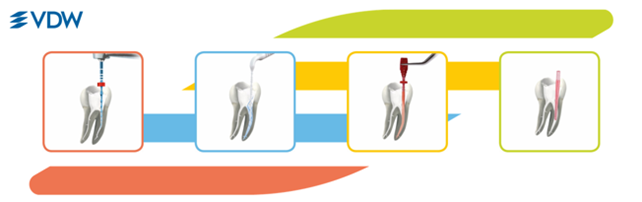
The production process begins with nickel-titanium wire blanks, which are fed into the machine and subjected to a precisely controlled sequence of grinding, optical inspection, black coating application (to improve visibility and length-marking accuracy during clinical use), and final finishing. The machine outputs one completed, inspection-passed root canal file every three seconds.
That production rate is, in itself, a significant engineering achievement. But it is the combination of speed with accuracy that defines the real challenge. During the grinding phase, the machine applies substantial cutting forces to material that must not be damaged, deformed, or compromised in any way. The grinding heads must move with micrometric precision under dynamic loading conditions, maintaining consistent positioning throughout a phase that lasts just one second per cycle. Across a full production shift, the cumulative mechanical demands on the components supporting that motion are considerable.
The Rollon Nadella AX needle thrust bearing solution
Accuracy is pivotal. But any component within the machine also needs to be able to handle heavy loads and strong acceleration forces.
To meet these demands, VDW integrated Rollon Nadella AX needle thrust bearings into its machine design – eight per machine, positioned to support the movement of the grinding heads during the machining phase. The selection reflects the specific engineering requirements of the application: high axial load capacity, sustained accuracy under dynamic loading, compactness and long-term reliability in continuous production.
The AX bearing achieves this through a design in which the rolling elements are retained and guided in radial pockets within the cage, with the cage itself secured relative to the plate via a steel ring. This configuration delivers the axial load capacity required to handle the forces generated during grinding, while the guided retention of the rolling elements maintains the accuracy of motion that the process demands. Critically, the assembly achieves all of this within a minimal footprint, which is an important consideration in compact machine architectures where space constraints are significant.
Stephan Schott, Industry Manager Medical at Rollon, explains: “The AX needle thrust bearing from the Rollon Nadella range was chosen for its high accuracy. The assembly provides high axial load capacity while occupying minimal space, making it well suited to compact machine architectures.”

Stephan Schott, Industry Manager Medical at Rollon
The bearing’s performance under repetitive high-speed cycling is equally important. With the grinding phase lasting just one second per component, the bearing operates in conditions of constant, rapid, reversing motion – a regime that places particular demands on rolling element retention and cage integrity. Performance degradation under these conditions is not acceptable; any inconsistency in motion at this stage translates directly into dimensional variation in the finished component.
Schott continued: “In applications like this, the component is not a passive element in the machine – it is an active contributor to accuracy. The bearing does not simply support the grinding head; it defines the envelope within which precision is achievable. That is why the engineering of the component itself matters as much as the engineering of the process around it.”
The value of long-term collaboration in a regulated industry
One aspect of the VDW and Rollon Nadella relationship that deserves particular attention is its duration. The current collaboration on the active machine design dates to 2001 – Nadella components were already integrated into predecessor machines built in 1986, at least one of which remains in production today. This is not a relationship defined by periodic re-specification and competitive tendering; it is a long-standing engineering partnership in which component performance has been validated across successive machine generations.
In regulated industries such as medical device manufacturing, this kind of continuity has practical as well as commercial value. Production consistency must be demonstrable over time, and changes to machine components carry qualification and validation implications. The ability to work with a supplier whose components have an established, documented performance history within a specific machine architecture reduces risk and supports the kind of continuous improvement that medical manufacturers need to pursue without disrupting qualified production processes.
Implications for medical device manufacturing more broadly
The dynamics in this case study, the convergence of speed, precision, load capacity, and long-term reliability within an increasingly compact and regulated production environment, are not specific to dental instrument manufacturing. They reflect a broader trajectory across medical device production, driven by the increasing complexity of medical devices, the expansion of automated manufacturing processes, and the tightening of the regulatory environment in which those processes must operate.
Schott added: “For instrumentation and manufacturing engineers working across the sector, this trajectory has a clear implication: the performance ceiling of a manufacturing machine is increasingly set at component level. Process optimisation, control system design, and machine architecture all matter, but if the motion components within the machine cannot sustain the required accuracy under the loads and speeds the process demands, the machine will not perform to specification consistently over time.
“This places a premium on component engineering that goes beyond standard catalogue selection. It requires suppliers who understand the specific demands of medical manufacturing environments: the regulatory context, the qualification requirements, the need for long-term supply security, and the value of engineering support that extends across the lifetime of a machine.
As medical device complexity continues to increase and performance expectations continue to rise, the component suppliers who can deliver at this level will play an increasingly central role in determining what medical manufacturing can achieve. Precision, in this context, is not only a product specification. It is an engineering discipline – one that begins at component level and shapes everything built around it.
For more information about Rollon’s motion components for medical device manufacturing applications, visit: www.rollon.com/gbr/en


