
An innovative architecture for coordinating low-level measurements from DC to 100 kHz
The Lake Shore MeasureReady™ M81-SSM (Synchronous Source and Measure) system provides a confident and straightforward approach for advanced measurement applications. The M81-SSM is designed to eliminate the complexity of multiple function-specific instrumentation setups, combining the convenience of DC and AC sourcing with DC and AC measurement, including a lock‑in’s sensitivity and measurement performance. Read the related lock-in amplifier app note.
This extremely low-noise simultaneous source and measure system ensures inherently synchronized measurements from 1 to 3 source channels and from 1 to 3 measure channels per half-rack instrument — while also being highly adaptable for a range of material and device research applications.
Components of the M81-SSM
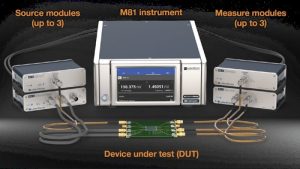
- Connect up to three source modules and up to three measure modules
- Exchange modules and adapt the configuration for each measurement
- All modules are capable of measuring with DC and AC to 100 kHz
- All modules are optimized for the highest precision with common amplitude and frequency references
Flexible measurement capabilities

The M81-SSM provides DC and AC stimulus and measurement capabilities for characterizing materials and devices in cryogenic, room temperature, and high-temperature environments.
Choose a combination of differential current source and voltage measurement modules for low-resistance applications requiring a precise stimulus current and the noise-cancellation benefits of balanced (floating) sample connections. Or mix and match with additional voltage source and current measurement modules for complex higher-impedance or gate-biasing applications where precise voltage control and sweeping test regimes are required.
Unlike a narrow-bandwidth DC system, these modules operate from very low frequencies to 100 kHz. You can select a measurement bandwidth to avoid 1/f noise and other bands where test environment noise is highest.
The system’s MeasureSync™ technology samples all sourcing and measurement channels at precisely the same time, enabling multiple DUTs to be tested under identical conditions so you can obtain consistent data.
Lake Shore MeasureLINK™ software can provide configurable measurement scripts and loops to support a variety of applications. It facilitates easy integration with Lake Shore cryogenic probe stations as well as third-party systems.
These combined capabilities make the M81‑SSM a superior solution for characterizing several test structures, including nanostructures, single- and multilayer atomic structures, MEMs, quantum structures, organic semiconductors, and superconducting materials.
The Lake Shore M81-SSM features:
| Unique real-time sampling architecture for synchronous sourcing and measuring | ||
|
||
| Designed for scientific-grade low-level measurement applications | ||
|
||
| The absolute precision of DC plus the detection sensitivity performance of AC instrumentation | ||
|
||
| Unique, flexible instrument/distributed module architecture | ||
|
||
DC transport
I-V curves, 4-wire
(VS module + CM module, primarily)
Ideal for: 2D materials, nanowires, organic semiconductors
M81 advantages: Low-voltage source noise, low-current measure noise
AC transport
AC resistance, sheet resistance, and AC current Hall
(BCS module + VM module)
Ideal for: Metal-insulator transitions, 2D materials, superconducting materials
M81 advantages: AC current Hall: synchronous measurement of resistance and Hall voltages; and simultaneous measurement of up to three devices in a cryostat at different frequencies
Photodiodes and phototransistors
(CM module + occasionally VS module)
Ideal for: IR sensitive materials, solar‑blind materials, 2D materials
M81 advantages: Programmable offset voltage source
Spin transport
(DC/AC: BCS module + VM module)
Ideal for: Spin-orbit torque (SOT), non‑local resistance, spin valves
M81 advantages: SOT: synchronous measurement of resistance, Hall voltages, and harmonic Hall voltages
Differential conductance
(VS module + CM module)
Ideal for: MIS junctions, Josephson junctions, defect characterization in transistors
M81 advantages: Junctions: dual DAC AC and DC sourcing (source at appropriate range)
Thermal transport
(AC, BCS module + VM module)
Ideal for: Thermoelectric materials, 1D materials
M81 advantages: Phase-correlated current sources, synchronous harmonic detection
For more information please contact Shayz Ikram on shayz@qd-uki.co.uk or visit
