
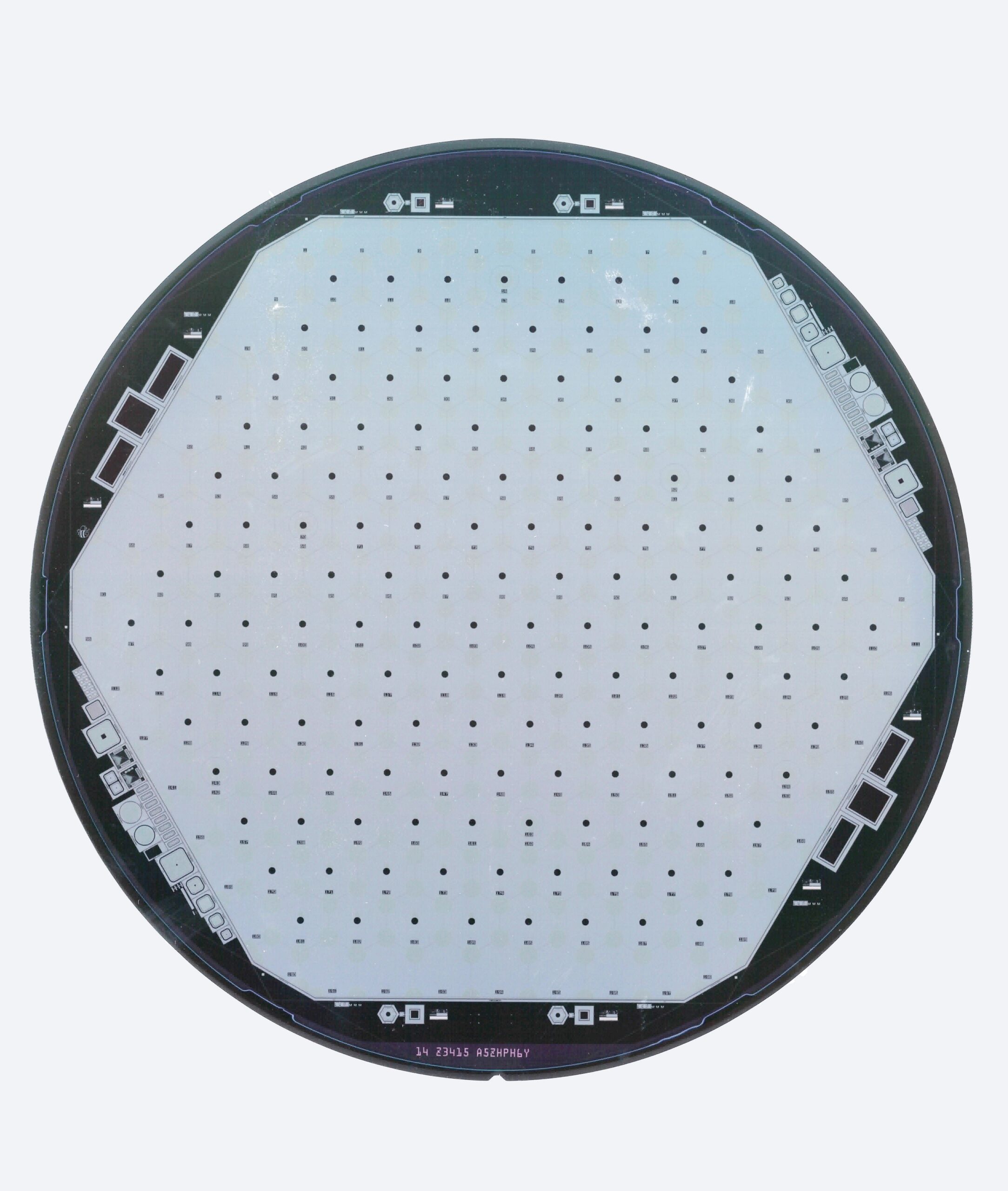
To meet the high-tech needs of the CMS experimental apparatus in the High Luminosity Large Hadron Collider (also known as the HL-LHC) experiments, Hamamatsu Photonics has designed and developed a unique 8-inch pixel array detector. This size makes it the world’s largest photodiode (PD) with high radiation resistance among PD detectors used in high-energy physics. At present, a mass-production system has also been created for this detector.
Hamamatsu has already supplied opto-semiconductors for the Large Hadron Collider (LHC) project, which is the HL-LHC predecessor, and is thrilled to have played a part in the discovery of the Higgs boson particles. The company’s new 8-inch pixel array detector has both high resistance to radiation and a large area required for the HL-LHC project. These features are expected to contribute to new research including more precise measurements of the Higgs boson properties and the search for dark matter.
Product Features
Hamamatsu’s 8-inch pixel array detector is the world’s largest PD array with high resistance to radiation among PD detectors used in high-energy physics applications for particle and radiation detection through the measurement of ionisation energy deposits.
PD arrays gradually lose their sensitivity while being exposed to radiation. Applying a higher voltage to the PD array can maintain high sensitivity even when exposed to radiation, but this is likely to damage the PD array. To meet the requirements of the HL-LHC experiments that call for high resistance to radiation, Hamamatsu successfully developed a large-area PD array prototype that can be made from a single 6-inch diameter wafer highly resistant to radiation and operates at voltages as high as 800 V. However, the European Organization for Nuclear Research (CERN) requires an even larger-area PD array to reduce both the costs and dead space of the entire detector system.
To utilise larger-diameter wafers as the material for a larger-area PD array, Hamamatsu installed new manufacturing equipment for an 8-inch diameter. Hamamatsu reviewed the manufacturing process conditions from scratch in order to improve the uniformity of the thin film thickness and impurity concentration formed on the wafers. The company also did this by harnessing the opto-semiconductor manufacturing technology it has collected over the years. By taking these steps, the company succeeded in fabricating a PD array that is about twice the area of the previous one while maintaining the same high level of radiation resistance. At the same time, by launching a new dedicated inspection system, capable of inspecting all channels on each PD array, Hamamatsu established a mass production system for the 8-inch PD array that meets the requirements of the CMS experimental apparatus in the HL-LHC experiments for both high radiation resistance and large surface area.
Development Background
At CERN, preparations are currently underway for the HL-LHC experiments where a higher frequency of proton-proton collisions will be carried out compared to the LHC experiments, in order to measure the Higgs boson properties more precisely and to search for dark matter, of which so little is known. Although more data can be obtained by increasing the frequency of collisions, this would generate higher radiation energy, so the PD arrays used to measure the energy must be highly resistant to radiation. Since a larger surface area was also required, Hamamatsu has been working on developing a larger-area PD array that is highly resistant to radiation.
Hamamatsu’s Role in LHC Experiments
Hamamatsu designed, developed, and supplied silicon strip detectors (SSD) for particle track detectors as well as photomultiplier tubes (PMT) and avalanche photodiodes (APD) for colorimeters to measure the radiation energy.
The LHC is the world’s largest accelerator with a total circumference of 27 km and is used to accelerate protons near the velocity of light to detect the Higgs boson which is very rarely emitted when the accelerated proton beams collide with each other. In 2012, the LHC experiments discovered the Higgs boson for the first time, and Professor Emeritus François Englert and Professor Emeritus Peter Higgs were awarded the Nobel Prize in Physics for their theoretical predictions.
