Most industrial sites are not short of data, they are short of visibility! Sensors are already installed. Machines are already running. Energy is already being consumed…but too often, the information that really matters is hidden away on clipboards, trapped on chart recorders, buried in data loggers, or locked inside equipment that no one is actively monitoring. The result is a series of blind spots that quietly increase cost, risk and inefficiency.
Turning those blind spots into insight starts with a simple question: What data do you actually need to see and what decisions would it allow you to make?
Where Do Industrial Blind Spots Come From?
Blind spots rarely exist because organisations don’t care. They usually exist because data collection has grown organically over time.
Many organisations still rely on manual processes. People walk around with clipboards, reading gauges or noting parameters once a shift or once a day. Chart recorders and data loggers capture information but they only reveal issues after the fact, assuming someone finds the time to download or check them.
Equipment often runs without clear visibility. Machines may be running longer than needed, starting and stopping more frequently than expected, or consuming more energy than anyone realises. Energy data is typically reviewed monthly, on a bill, long after the opportunity to change behaviour has passed.
Each of these gaps creates risk. Missed alarms. Late reactions. Higher energy bills. Preventable incidents. A growing reliance on “experience” and assumptions instead of evidence.
What Does Visibility Really Means?
True visibility is not about flooding people with dashboards or raw data. It is about making the right information visible, to the right people, at the right time.
That often starts by adding connectivity to existing sensors, rather than replacing them. Level sensors, pressure sensors, temperature probes and flow meters already tell a story. Connectivity simply allows that story to be read in real time, rather than retrospectively.
It also means replacing manual recording with automated capture. When data flows directly from sensors and machines into an online system, readings become consistent, reliable and available, without someone having to remember to write them down.
For older equipment, chart recorders and standalone loggers can still play a role, but the insight improves dramatically once their data is visible online, stored securely and made searchable. Trends that were once hidden on paper or isolated files suddenly become clear.
How To Move From Data To Insight
Visibility alone is useful. Insight is transformative!
Once data is live and accessible, patterns start to emerge. Operators can see when machines start and stop, how long they actually run for and how those run times relate to output, maintenance or faults. Similar processes can be compared for anomalies. Energy consumption can be tied directly to activity, not just averaged over a month.
Alarms become proactive instead of reactive. Instead of discovering a problem during the next manual check or … even worse, after an incident … alerts can highlight abnormal conditions as they develop. High usage, unexpected starts, levels approaching limits or equipment not behaving as expected can all trigger timely intervention.
Crucially, this shifts organisations away from firefighting and towards control. Decisions are based on facts, rather than assumptions. Improvements can be measured rather than guessed at.
Reducing Cost, Risk And Effort
The practical outcomes of improved visibility are consistent across many industries.
Operational incidents fall because abnormal conditions are flagged earlier. Maintenance becomes more targeted because run hours, cycles and behaviour are known, rather than estimated. Energy costs reduce, because consumption is understood in context, not just as a headline number.
Compliance and reporting also improve. Automated data collection creates accurate, time‑stamped records, no longer relying on manual input. Audits become easier. Investigations become clearer. Teams spend less time gathering information and more time acting upon it.
People are freed from repetitive tasks. Engineers and operators can focus on solving problems and improving processes, rather than collecting data for its own sake.
Seeing What Matters
Digital transformation does not start with big, complex systems. It starts with visibility.
By identifying where blind spots exist whether that’s unconnected sensors, manual checks, offline recorders or unseen machine behaviour, organisations can take small, practical steps to turn hidden data into insight.
Seeing what matters means understanding what is happening now, learning from what has already happened and acting before small issues become expensive ones. In an industrial world where margins, energy costs and compliance pressures are only increasing, the ability to see clearly is no longer a luxury it is a competitive advantage.
PowTechnology have designed, manufactured and supported remote monitoring & data driven solutions globally for over 35 years, with an enviable track record for robust IIoT solutions, continuous innovation and successful customer outcomes. 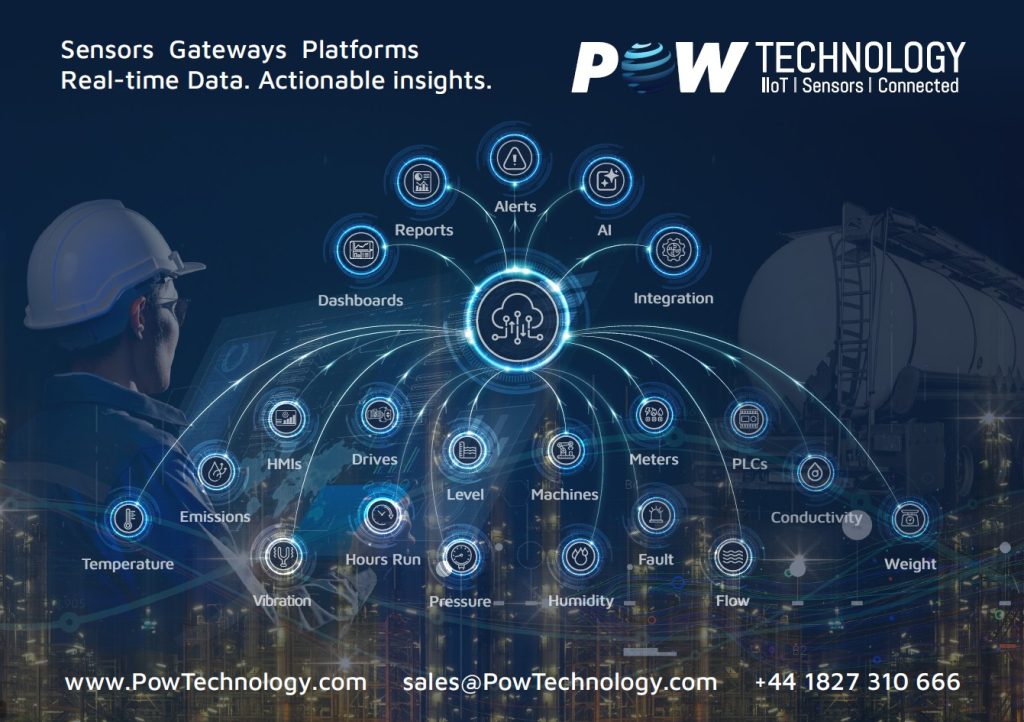
PowTechnology partner with you, understanding your processes and business objectives to help you achieve your objectives, be they efficiency, safety, sustainability or service. We can offer practical suggestions on where smart remote monitoring technology could have the greatest impact!
Fancy a chat?
+44 1827 310 666 sales@PowTechnology.com or use this contact form.
Read other recent instrumentation news: https://instrumentation.co.uk/category/news/