
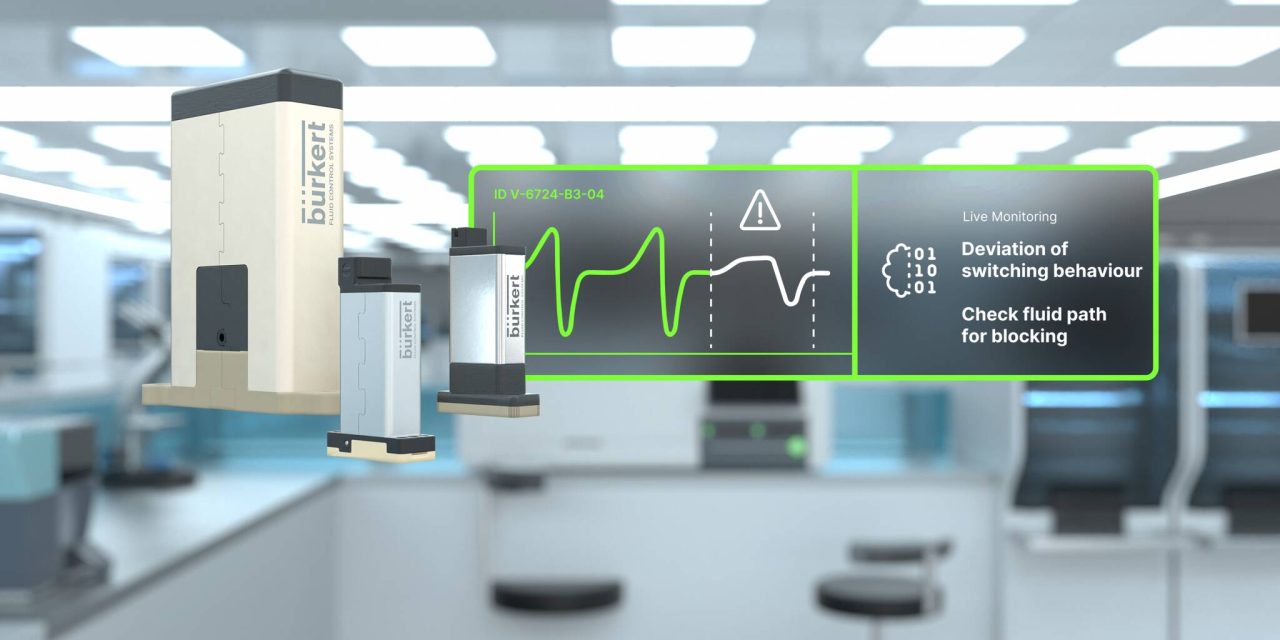
Greg Wainhouse, Regional Business Development Manager – Industrial Water, North Europe at Bürkert, explains how targeted data from field-level devices can improve water treatment efficiency, support environmental compliance and reduce maintenance costs.
Across the UK and Europe, water utilities are under pressure to optimise environmental compliance while improving efficiency and cost control. Digitisation has long been seen as key to increasing plant intelligence and identifying areas for improvement, yet the challenges remain.
While investment in digitisation isn’t uniform across national regions, the water sector as a whole generates a high volume of data. Despite the visibility that this data offers, blind spots relating to process performance, efficiency and maintenance still exist. Is the issue too much data, with challenges surrounding its effective management and use, or is there still a lack of data at critical points in the system?
Digitising field-level devices
Across the data hierarchy of the automation pyramid, a focus on the enterprise layer is crucial to determining overall performance and cost. SCADA systems contribute directly by presenting plant-level metrics, while PLC-managed data feeds this layer and converts system-level information to inform process decisions. At each level, the data is accessed by a corresponding stakeholder, creating a context-based hierarchy. The challenge, however, is that senior management might prioritise enterprise- and plant-level automation investment over devices involved in field-level digitisation, risking data gaps.
Clearly, a wide range of field equipment, such as valves, sensors and flowmeters, is already integrated to enable the flow of data to top-level enterprise or plant layers. However, when digitising a water treatment plant, devices that could provide valuable data are easily overlooked. It may not be practical to integrate every device within a digital system, particularly when considering costs. Moreover, the high volume of field-level devices to review, alongside competition for budgets from stakeholder-prioritised higher-level automation, can increase the likelihood of their exclusion.
Sufficient coverage of field-level devices within a water plant’s digital network matters because gaps can create additional costs or missed opportunities to improve water treatment efficiency. The reality is that a low-cost solenoid valve can influence plant-wide performance. For example, a wastewater sensor costing over £50,000 can be disabled by a maintenance problem with its cleaning mechanism, caused by the failure of a £100 solenoid valve. In situations like this, adding digital feedback can be crucial to informing system-critical maintenance and ensuring sensor availability, as well as reducing total costs through improved maintenance regimes.
Valve data and water analysers
To implement efficient and diligent digitisation of field-level devices, a thorough audit of the architecture provides a robust approach. While this should involve input from operational and maintenance teams at device level, the scope of the audit should also include process instrumentation, such as water analysers. This is where there’s a crucial distinction: the accurate integration of information from this level of instrumentation doesn’t directly contribute to the big data that informs plant performance and efficiency. However, it does provide high-value data that could be critical to plant compliance and performance, albeit based on the analysis of extremely small volumes of water.
Analysis at the microfluidic level spans sampling from raw water through to the disinfected water stage, and can also include sampling within the distribution network, as well as wastewater. Within these systems, valves are relied on for the flow of samples and reagents, and their performance is critical to the accuracy and repeatability of analysis. A failure to open or close, a partial stroke or a deterioration in switching can all affect the validity of analysis. This can result in a failure to accurately measure parameters such as chlorine or turbidity, which could lead to critical compliance issues.
Approaches to data feedback
Using analysis instrumentation with standardised NAMUR analogue signals can inform the PLC whether a sample or reagent dosing valve is open or closed, indicate faults such as sensor failure, and show whether the analysis device is inside or outside the expected range.
Position control devices used with valves from Bürkert extend beyond NAMUR or binary feedback by providing more detailed information on valve behaviour, such as continuous or proportional position data, stroke timing and the status of the commanded position. This approach requires additional hardware, such as integrated position sensors or actuator-mounted feedback, preferably with industrial protocols based on digital communications to provide PLCs directly with more granular data. The advantage is a more detailed understanding of valve operation, providing a foundation for a more holistic view of water analysis system performance and health.
ValveInsight
Taking this approach further, Bürkert also provides the ValveInsight service, using the valve itself as a sensor to identify subtle changes in valve behaviour that a positioner alone may not detect, resulting in more detailed diagnostics.
This capability involves the analysis of an electrodynamic actuator that contains a coil within a magnetic field. When electrical current flows through the coil, it generates a Lorentz force that moves the coil to produce precise and rapid motion that actuates the valve. As the coil moves within the magnetic field, it generates an induced current, the analysis of which provides precise measurement of valve stroke across a wide range. As a result, ValveInsight can accurately monitor switching status as well as wider factors that influence valve switching behaviour.
For water analysis systems, ValveInsight can provide immediate detection of faults or deviations, enabling a rapid response to challenges in quality and conformance, as well as supporting process documentation. A further advantage of the system is its diagnostic flexibility. ValveInsight uses algorithms that are offered as open source on the developer platform GitHub. These can be integrated into third-party, higher-level control systems, with the algorithms trained for specific analysis conditions. Simple to integrate, the ValveInsight capability is included in Bürkert’s Whisper Valve technology.
Taking the wastewater sensor example previously mentioned, a solenoid valve with ValveInsight and its free software could have alerted the controller to the gradual deterioration in valve performance, preventing total sensor failure. While there’s always an emphasis on ensuring performance during commissioning, this focus can drift as the system ages, compounded by a lack of resources for accurate and timely condition monitoring. As a result, device failure in the field occurs all too often.
Improving water treatment efficiency without data overload
To optimise water treatment efficiency, performance and environmental compliance, using data is crucial. This means accurately obtaining the right level of data granularity throughout the automation pyramid. While including data from previously overlooked, common field-level devices could be critical, the focus should remain on obtaining the right data, rather than simply collecting more data.
A thorough audit of valuable data points is vital, combined with an understanding of the type of data that’s most useful, as well as the speed and accuracy of its delivery. Valves and sensors are integral to the performance of water treatment plants, both at the macro and micro level, and the technology available now enables a high degree of flexibility in the level of data granularity that can be achieved.
Read other recent instrumentation news: https://instrumentation.co.uk/category/news/


