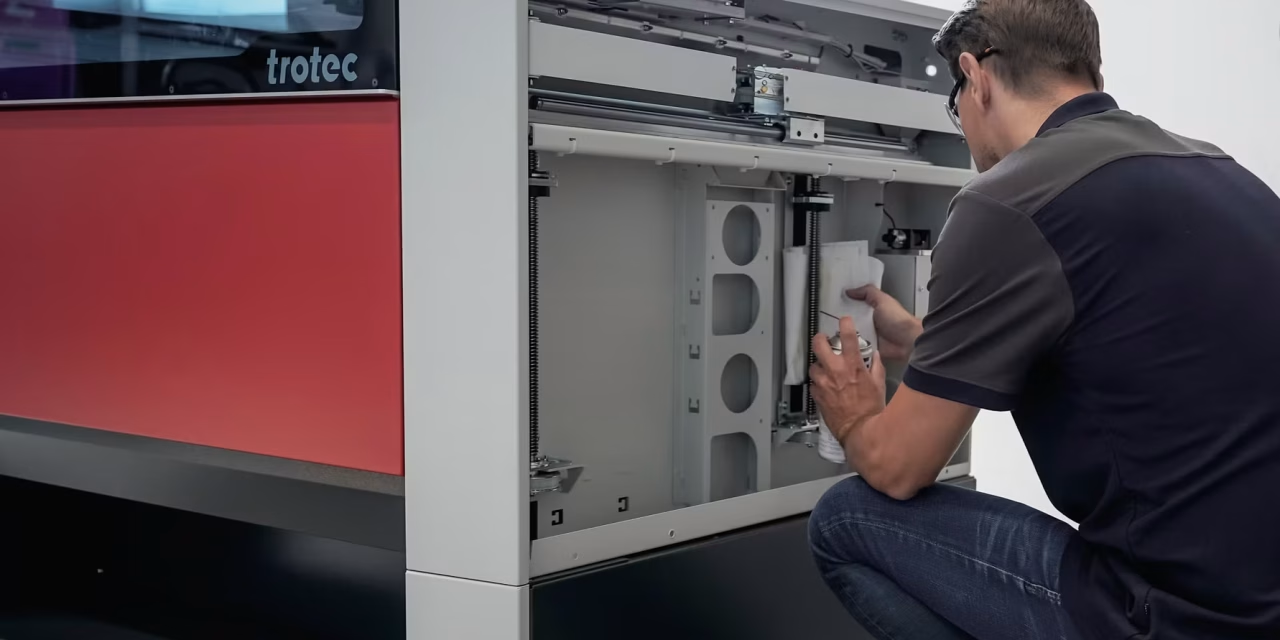
Why Traditional Maintenance Approaches Are Insufficient for Industrial Lasers—and How Systematic Fault Analysis, Software, and Self-Service Concepts Reduce Hidden Cost Drivers
In many manufacturing facilities, laser systems are considered precise, reliable, and cost-effective. But as with any technical equipment, practical experience with this technology reveals unplanned downtime, quality fluctuations, and opaque downtime—factors that often significantly drive up actual production costs. This becomes particularly critical in in-house manufacturing, where every interruption has a direct impact on unit costs.
Hidden Costs: More Than Just Machine Downtime
The direct costs of a laser failure are relatively easy to quantify: machine downtime, production delays, and, in some cases, scrap. The indirect consequences, however, are far more significant:
• declining equipment efficiency (OEE)
• increased rework and quality issues
• inefficient use of personnel
• loss of on-time delivery reliability
These factors mean that calculated unit costs often deviate significantly from actual costs. Especially during periods of high capacity utilization or mass production, even brief interruptions add up to a significant economic risk.
Why Traditional Maintenance Approaches Have Reached Their Limits
In many companies, maintenance is still based on two fundamental principles: reactive repairs in the event of a breakdown or rigid maintenance intervals. However, both approaches fall short:
• Reactive maintenance is only implemented after costs have already been incurred
• Time-based maintenance does not take the actual condition of the equipment into account
• Root cause analyses often remain superficial and symptom-oriented
The result: recurring failure patterns, inefficient service calls, and a lack of transparency regarding the actual weak points in the process.
Internal Failure Analysis as the Key to Cost Reduction
A key lever lies in systematic internal failure analysis. The goal is not only to resolve malfunctions but to eliminate their root causes in the long term.
Successful approaches include:
• Structured recording of malfunctions and downtime
• Analysis of process and machine data
• Identification of recurring patterns
• Clear classification of causes (process, operator, technology)
Only this level of transparency makes it possible to derive targeted measures—such as parameter adjustments, training needs, or preventive replacement cycles for critical components.
Digital Transparency as the Basis for Informed Decisions
A key success factor for modern maintenance strategies is the availability and systematic use of production data. In many facilities, however, this very transparency is lacking: while malfunctions are documented, they are not analyzed in a structured manner or correlated with process parameters.
This is where digital software solutions come in, consolidating production and machine data and presenting it clearly. They make it possible to identify recurring error patterns more quickly and pinpoint causes more precisely.
One example is integrated laser software solutions such as Trotec Ruby®, which map the entire workflow from job preparation to execution while simultaneously creating a consistent database. Through centralized control and traceability of process parameters, deviations can be identified more quickly and avoided in a reproducible manner. In maintenance in particular, this creates a consistent data foundation that helps not only to resolve downtime more quickly but also to systematically prevent it.
In concrete terms, this means the following for maintenance:
• better traceability of fault causes
• faster diagnosis of malfunctions
• well-informed decisions instead of reactive measures
As a result, software becomes an essential component of the maintenance strategy—not as a substitute for technical measures, but as the foundation for their targeted implementation.
Predictive Maintenance in Lasers: From Reacting to Thinking Ahead
At the same time, predictive maintenance is becoming increasingly important. Instead of relying on fixed intervals, the actual condition of the equipment is continuously monitored.
Typical elements include:
• Condition monitoring of relevant components
• Data-driven wear forecasts
• Early planning of service calls
This significantly reduces unplanned downtime, while maintenance measures are carried out in a more targeted and efficient manner.
The combination of software-supported process monitoring and predictive maintenance opens up additional potential: When historical production data is systematically analyzed, patterns can be identified that indicate impending wear or unstable processes.
In laser-based manufacturing in particular, this enables early planning of maintenance measures—before unplanned downtime occurs.
The Often Underestimated Factor: Process and Operational Expertise
In addition to technology and data, another factor plays a decisive role: operational know-how. Many malfunctions cannot be attributed solely to technical defects, but rather to process deviations or operator errors.
This is where combined training approaches come into play, addressing both production and maintenance:
• Production training to optimize parameters and throughput
• Technical training on maintenance, repairs, and systematic troubleshooting
• Building internal expertise for faster problem-solving
By integrating knowledge and technology in this way, companies can operate their facilities more reliably and reduce their dependence on external service providers.
Rethinking “Make or Buy”
The question of whether components should be manufactured in-house or outsourced is increasingly being reevaluated from a cost perspective. In this context, hidden maintenance costs are coming into sharper focus.
Companies that professionalize their maintenance strategy lay the groundwork to:
• realistically assess the cost-effectiveness of in-house production
• sustainably optimize their cost structure
• respond flexibly to market fluctuations
Self-Service in Maintenance: Actively Managing Availability
In addition to data-driven analysis and targeted training, another approach is gaining increasing importance: the strategic shift of maintenance tasks into the production operation itself.
The goal is to reduce dependence on external service calls and significantly shorten response times in the event of malfunctions. This shifts maintenance from a reactive service call to an actively managed component of production. In practice, this means structuring maintenance in such a way that defined tasks can be reliably handled internally.
This includes, among other things:
• clearly defined spare parts inventories maintained on a system-specific basis
• independent reordering of components to avoid bottlenecks
• modular systems that enable the rapid replacement of assemblies
Particularly for laser systems operating at high capacity, the replacement of key components by trained in-house personnel can play a decisive role in drastically reducing downtime.
However, this requires a combination of technical system design and targeted skills development. Standardized training programs make it possible to teach maintenance and service tasks in a structured manner and to perform them safely.
Combined with transparent process data and clearly defined maintenance strategies, this creates a maintenance approach that is not merely reactive but actively contributes to production stability.
Conclusion: Maintenance as a Strategic Production Factor
While the market has traditionally focused on machine performance and acquisition costs, practice reveals another decisive success factor: the quality of maintenance and process management.
Data-driven failure analysis, combined with predictive maintenance and targeted skills development, makes it possible to identify hidden costs and reduce them permanently. In laser-based manufacturing in particular, maintenance thus transforms from a reactive cost factor into an active driver of productivity and cost-effectiveness. Trotec Laser has recognized these trends and is working intensively to further develop its existing software, service, and training offerings to provide its customers with optimal support in this process.
Read other recent instrumentation news: https://instrumentation.co.uk/category/news/