
Municipalities have been investing heavily in analytics and digital twins for years with the aim of predicting overflow events, managing stormwater surges and automating complex collection networks. However, the accuracy of algorithms depends entirely on the quality of the field data feeding them. If a primary level sensor delivers inaccurate readings, the entire digital twin generates false analytics. This can turn an expensive automation investment into an operational liability.
As such, level measurement must be treated as a baseline data security asset rather than a basic mechanical utility. That means selecting reliable field instrumentation is no longer just a routine specification choice; it is the fundamental requirement for true digital transformation.
Limits of legacy instrumentation
For decades, utilities relied on differential pressure (DP) diaphragms, bubblers and legacy ultrasonic transmitters to monitor collection basins and storage tanks. However, hydrostatic and DP pressure transmitters measure level based on liquid head pressure, making them sensitive to density variations. In wastewater collection, fluid density changes with temperature and liquid composition.
Legacy ultrasonic transmitters, meanwhile, rely on sound waves travelling through air, and changes in temperature, as well as the presence of condensation, mist or heavy foam, can damp or distort the signal. Additionally, the wide angle of most ultrasonics means the beam frequently strikes internal ladders, agitators or structural steel, creating false echoes that confuse the transmitter.
When sensors fail, human intervention is required. But in modern utility operations, skilled maintenance crews are stretched thin, often relying on contracted labour or off-site operators in a central control room. Technicians can no longer continuously clean coated sensors or adjust output signals. Yet unchecked sensor errors can lead to unexpected tank spills, odour complaints and other problems.
How to get absolute data purity
For these reasons, utilities are transitioning towards high-frequency non-contacting radar. High-frequency 80 GHz radar operates independently of fluid density, temperature, pressure and vapour conditions, providing the consistent accuracy required for predictive modelling.
While lower-frequency radars, such as 10 GHz or 24 GHz, emit a broader signal cone that easily bounces off internal vessel obstructions, requiring extensive software filtering to mask false echoes, an 80 GHz radar concentrates energy into a tight, narrow waveguide. This allows the signal to shoot cleanly through small nozzles and past internal obstacles such as ladders, pipes or sidewall build-up, focusing directly on the liquid surface. High-frequency radar accurately tracks the true liquid level without getting lost in background noise.
Of course, performance also depends on how the signal is processed. Frequency-modulated continuous-wave (FMCW) transmitters sweep through a continuous frequency range, for example, modulating from 79 GHz to 81 GHz, while transmitting and receiving simultaneously. Comparing the frequency difference between the transmitted and received signals allows the device to calculate distance with the highest possible level of precision (Figure 1). In addition, continuous processing lets the radar evaluate signal plausibility in real time, filtering out abnormal jumps and verifying that the returned signal represents the actual fluid surface before sending telemetry to the SCADA system or digital twin.
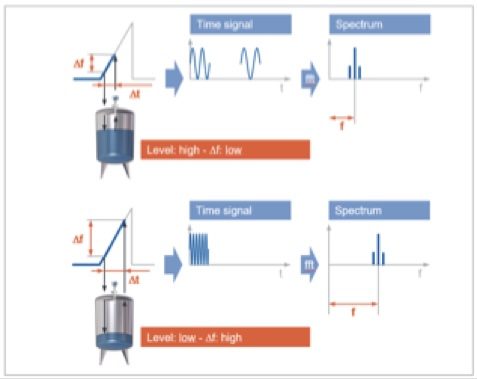
Figure 1. Frequency-modulated continuous-wave (FMCW) measures distance indirectly via the frequency resulting from the difference between the emitted and received waves. This frequency difference is then converted into a signal spectrum through a quick FFT (fast Fourier transform) to calculate the distance.
Built for harsh wastewater environments
Wastewater collection networks are challenging environments for any kind of instrument. Components are exposed to aggressive off-gassing, high concentrations of hydrogen sulphide and sticky biological build-up. Modern radar transmitters must utilise specialised materials such as polytetrafluoroethylene (PTFE), polyether ether ketone (PEEK) and polyvinylidene fluoride (PVDF), which offer superior corrosion resistance compared with traditional stainless steel or lower-grade plastics. This ensures that harsh chemicals and corrosive gases do not compromise the enclosure.
Simplifying deployment and system maintenance
Transitioning to 80 GHz radar does not require complex installation procedures or lengthy commissioning cycles. Modern compact series, such as the KROHNE OPTIWAVE 1500, are designed as drop-in replacements for outdated ultrasonic and hydrostatic devices.
Integrated Bluetooth connectivity allows technicians to configure, diagnose and validate sensors safely from a smartphone or tablet using secure apps. Commissioning can be completed in minutes using guided set-up routines. If an installation features unique internal geometries, operators can perform a partial empty-tank spectrum scan, so the device automatically ignores structural background noise. Furthermore, modern diagnostic tools generate shareable HTML validation reports directly from the field. If a transmitter encounters an unexpected signal anomaly, field personnel can email the complete signal spectrum log to support teams for analysis.
Securing the automated network
Utility automation, AI forecasting and digital twin modelling are powerful tools for modern water management, but their value is fundamentally anchored to the field sensors measuring physical realities. By upgrading to robust, non-contacting 80 GHz FMCW radar, utilities can eliminate measurement error at the source. Reliable, maintenance-free level data ensures that predictive algorithms are able to protect infrastructure, prevent overflows and secure the future of utility automation.
Read other recent instrumentation news: https://instrumentation.co.uk/category/news/