
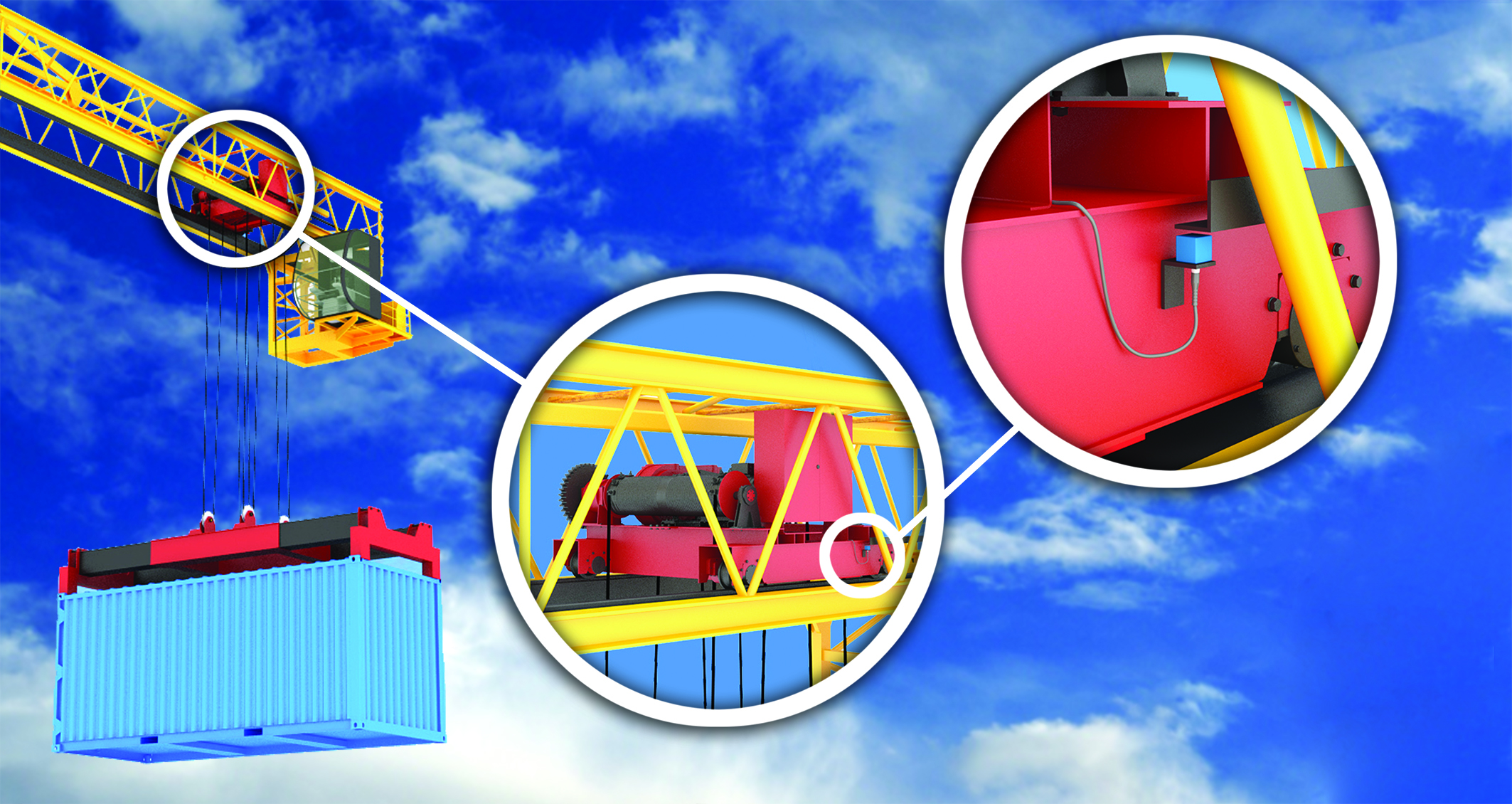
The UK’s busiest container ports handle over 1.5 million shipping containers per year and so rely on the high performance and reliability of their container-handling cranes. Contrinex’s rugged ‘600 Series’ inductive sensors play a key part in this, being trusted to prevent the crane’s carriage from travelling outside preset limits. Because mechanical play in the hoist carriage allows a small amount of lateral drift as it travels along the crane structure, Contrinex’s long sensing distance is essential for reliable detection.
Customer application
Britain’s busy container ports are 24-hour, 365 days a year operations, where storage space is highly optimised to achieve the extreme levels of efficiency required. Long-reach container-handling cranes have a hoist carriage which traverses the crane’s beam, to lift and lower containers into all parts of the large storage areas. Sensors are used to prevent the carriage from travelling beyond allowable limits by detecting the ends of the structure and stopping the drive motors.
Mechanical play and movement in the drive system makes reliable detection a challenge, The carriage can drift laterally as it travels along the crane structure and the 15mm sensing range of a competitor’s sensors were proving to be inadequate. When the competitor’s sensor didn’t detect the carriage, it could collide with the crane’s structure, causing damage and interrupting operation. Therefore better inductive sensors with increased sensing range were needed to prevent collisions.
Customer solution
Contrinex’s ‘600 Series’ of basic inductive sensors, available from PLUS Automation, are ideally suited for this application. Mounted in rugged 40 x 40mm polyamide glass-fibre housings, these devices offer a sensing distance of up to 40mm, although the 20mm version is sufficient to eliminate the risk of collision in this application. The sensor’s IP68 / IP69K rating is ideal for this outdoor working environment, even at a seaport.
The sensor uses an industry-standard housing style, originally used by mechanical breakers, which meant that the Contrinex sensors were drop-in replacements for the competitor’s units. No modification to the mounting arrangements was necessary, and the end-user appreciated the short downtime during the changeover to the Contrinex inductive sensors.
Communication with the crane’s control system is via a PNP changeover interface. A flexible PUR-sheathed cable is used with the sensor’s M12 connector, enabling easy removal and replacement for maintenance. This style of inductive sensor is also offered with a 2-wire connection for the direct replacement of mechanical breakers.
A step improvement in operational performance was evident immediately after the Contrinex inductive sensors were installed. The new sensors provide reliable sensing of each hoist’s position with no reported collisions since the date of installation. The customer has reported a marked reduction in crane downtime with an associated decrease in expenditure on replacement sensors.
