
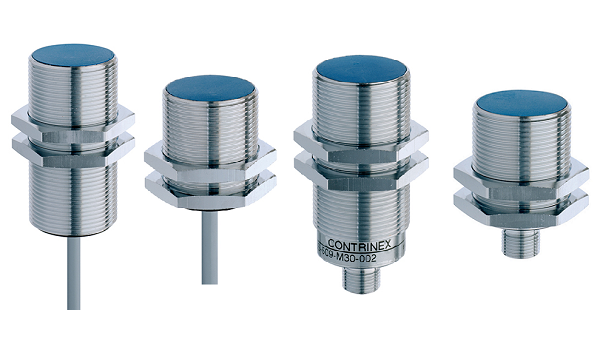
The speed and precision of Contrinex’s analogue inductive sensors are trusted in a diverse range of applications and industries and one such example is rail transportation. A German technology-leading manufacturer of sustainable urban transportation systems uses them to help it ensure safety and efficiency to optimise the performance of its trams. The sensors provide continuous data on the movement and vibration of the tram’s primary suspension spring.
Customer application
The customer, in collaboration with engineers from the Technical University of Dresden and the city’s Public Transport Authority, wanted to improve the reliability and energy efficiency of a fleet of trams.
To improve the smoothness and comfort of the tram, the team aims to capture all movement in the primary suspension spring, including every vibration. Therefore an analogue output sensor is required to give the speed and high-resolution measurement required.
The harsh environment within the suspension demands an extremely robust, contactless sensor with long operating distances and resistance to wear and dirt.
Customer solution
Contrinex’s Extra Distance Analogue Output inductive sensors, available from PLUS Automation, are well suited to this application with their excellent resolution (in µm range), being able to monitor vibration, detecting motion so that the tram’s systems can be optimised to improve the smoothness of travel.
The sensors use the patented Condist oscillator technology to provide enhanced environmental stability, which provides a longer operating distance of up to 40 mm (almost 3 times that of a conventional sensor) on the moving spring target.
The distance between the spring and sensing surface is measured by the analogue sensors to track the spring’s motion, including vibrations, as a continuous signal. The data collected is stored on an external hard disk which is read by the service engineer. GPS position data helps correspond spring movement and mechanical loads to precise locations for each point in the journey.
