
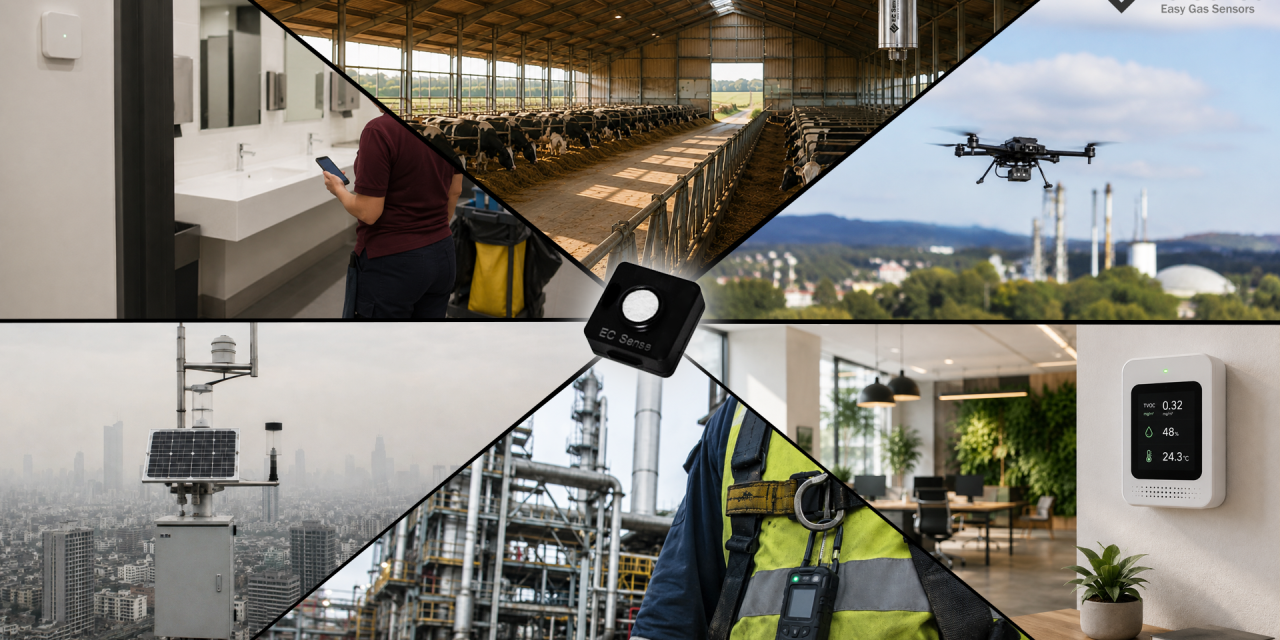
They are smaller than a postage stamp, cost between five and twelve euros – and are suitable for virtually any type of application. From classic safety use cases to the most advanced innovations, the possibilities are almost limitless. This is gas sensor technology 2.0. A company from Munich has developed a technology that, for the industry, is the equivalent of the leap from the push-button phone to the smartphone – with all the implications that come with it.
Some companies change an entire industry quietly, almost unnoticed. No billions in backing, no Silicon Valley hype, no keynote spectacle in front of thousands of people. Just a small team south of Munich, a machine capable of producing up to ten million sensors per year, and an idea that no one had had before – or at least had never been able to implement technically. Founded in 2015, EC-Sense has moved beyond the startup phase and is now doing what true hidden champions do: fundamentally reshaping a technology and digitizing an industry that has remained stuck in the analog world for decades.
The Gas Sensor That No Longer Needs Liquid
To understand why this is such a big deal, it is worth taking a brief look at the world of conventional gas sensor technology. For around 40 years, electrochemical gas sensors have worked according to the same principle: inside a cylindrical housing there is a liquid electrolyte. Ambient air enters, reacts with the liquid and generates an electrical signal. This signal is read out and converted. The result shows how many ppm – parts per million – of a gas, such as carbon monoxide, ammonia or hydrogen, are present in the air.
But this principle comes with a number of drawbacks. The liquid can leak, creating a leakage risk that can damage devices and endanger people. The sensors are relatively large, heavy and bulky because they require a small container for the liquid. They are manufactured exclusively by hand, piece by piece, which is labor-intensive and time-consuming. And they require regular recalibration because of what is known as zero-point drift: the sensor’s zero value shifts and displays a reading even when no gas is present.
EC-Sense has overcome all of this with a new technological approach. Instead of a liquid electrolyte, the Munich-based company uses a solid polymer electrolyte – printed directly onto ceramic. The company’s Managing Director, who has more than 40 years of experience in gas detection, developed these solid-electrolyte sensors. The operating principle remains electrochemical.
The finished sensor is one centimeter long, 0.8 centimeters wide and one millimeter thick. Because no liquid acid is used, it is guaranteed to be leak-free. No risk to the device in which it is installed, and no risk to the person operating it. And there is no zero-point drift. This makes the sensors user-friendly and low-maintenance. More than 100 gases can be detected with the technology – virtually all gases that can be measured electrochemically. Parameters such as temperature and humidity, which can influence gas measurement results, can also be recorded.
Small, Quiet, Self-Powered
The size of the sensor is not only crucial for functionality. It is also where the business model begins. Then there is the power consumption – or, more precisely, the energy saving. An EC-Sense sensor works like a miniature fuel cell: it generates its own electricity and does not drain the device into which it is integrated. That may sound like a detail, but it is an innovation for battery- or solar-powered applications. Sensors that previously consumed battery power now enable downsizing and smart, modern solutions.
The sensors respond within just a few seconds. Their service life significantly exceeds that of conventional solutions – even in environments with high ammonia levels in the air, such as agriculture, where other sensors fail after only a few months, the EC-Sense sensor is still running after five years.
The Machine That Changes Everything
Alongside the core technology itself, production is what sets EC-Sense apart from the competition. Conventional gas sensors are made by hand: many employees, long lead times, high error rates. At EC-Sense, production is fully automated using a single machine, including optical inspection under a microscope and permanently reproducible results. At full capacity, up to ten million sensors per year are possible. Today, the company produces several hundred thousand. And demand is growing. Almost every day, the founders say, inquiries arrive from gas sensor application fields they themselves had never even thought of.
Wildfires, Diapers and Restrooms
Anyone who associates gas sensor technology only with measuring devices and laboratory air has not yet heard of the following customer applications.
There is early wildfire detection. The small sensors are attached to trees – green, inconspicuous, about five meters above the ground – and form a network. They measure and detect where a smoldering fire starts before it turns into a blaze.
There is incontinence detection. A clip on a diaper contains a sensor that measures what has happened, connected to an app that informs care staff. Targeted intervention instead of routine rounds. Less effort, more dignity.
There are public restrooms in trains, airports and gas stations. A current use case is in India – a country where cleaning staff are scarce, while hygiene remains essential. The sensor measures air quality. If a threshold is exceeded, cleaning staff are sent in and can clean precisely where needed. This conserves resources while ensuring quality.
There are insect farms in France. Tons of larvae writhe there, bred as feed for salmon, chickens and other livestock. High ammonia concentrations can become dangerous for employees. The sensor measures, warns and protects. And then there is space. EC-Sense sensors have been launched into orbit on a rocket: oxygen monitoring on the ISS. No joke.
The Market Hesitates – and That Is a Good Thing
EC-Sense knows where it stands. It still has to prove itself. The market for electrochemical gas sensors is conservative. Never change a running system – that is especially true for safety-relevant devices that need to be certified, that have to pass through process cycles, and that are expected to run reliably in industrial plants for years. Established providers enjoy trust. New technology first has to earn that trust.
The major players are watching. They are observing how EC-Sense grows. Some are trying to build something similar – liquid sensors in smaller designs, less electrolyte, more compactness. But the old principle cannot simply be downsized. The disadvantages of liquid do not disappear just because less of it is used.
EC-Sense is, in fact, hoping for a competitor that succeeds in copying its approach. Because that would mean market acceptance and a broad breakthrough. Once the big players start building solid-electrolyte sensors, the technology will have won. EC-Sense will no longer be the outsider. It will be the pioneer.
The coming years, according to EC-Sense, will also be defined by convergence. Industrial gas sensors will finally arrive where other technologies have long since been: small, digital, connected and efficient.
Changing the Future
The electrochemical gas sensor market has looked the same for 40 years. Huge sensor discs. Outdated design. Yesterday’s technology in today’s devices. EC-Sense wants to change that. With a sensor that is smaller than a postage stamp, consumes no power, never leaks – and is in the process of making the world of gas detection safer, cleaner and smarter.
Read another recent EC-Sense article: https://instrumentation.co.uk/next-gen-of-gas-detection/


