
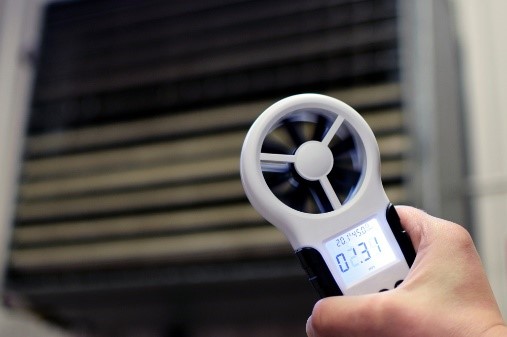
 Anemometers are devices that have traditionally been used for measurement of wind speed and direction for meteorological data requirements. Evolution and technological advances across the globe have seen the expansion of anemometer use into many varying sectors for measurement such as; duct velocity in HVAC systems, fume hood performance in laboratories, aerodynamic development for vehicle transportation, exhaust stack flow for environmental emissions, fluid dynamics and so on. They are now a fundamental day to day measurement across a variety of industries and just as new sectors arrive so do new instrument, methodologies and measurement techniques.
Cost / Performance Ratio
Apart from the minority, we are all subject to cost constraints for our instrumentation purchases and a compromise often necessitates a suboptimal instrument to keep within our budgets. Understanding your application, operating conditions and required measurement uncertainty are fundamental to ensuring your anemometer selection is both cost effective and technically conformant.
Types of Anemometer
Cup Anemometer, is one of the oldest types of anemometer, commonly used in the Meteorological sector for weather measurement of wind speed and direction and are often seen on masts, cranes, weather station, airports, boats, oil rigs and towers. They are a robust style meter that continues to prove itself in the harshest of environments. They generally have 3 or 4 cups, which as the wind blows, the cup rotates and outputs a frequency. The faster the cup rotates the higher the frequency and a calibration of frequency against air velocity is derived. They do not need to be pointed into the direction of wind so are ideal for remote, permanent installations but as a mechanical device they are prone to friction and have a higher start-up speed of above 0.2 m/s. Many older devices were prone to icing, but now most models are available with retrofit anti-icing or available as heated models. Due to their size and flow blockage they pose a problem for many calibration laboratories due to the size of wind tunnel required to successfully calibrate these devices. There are only a handful of UK commercial calibration laboratories that can undertake rotating cup anemometer calibration.

Rotating Vane Anemometer is also a mechanical type meter where increasing air speed causes the vane to rotate at high speeds and a frequency to air velocity calibration is derived. In this case, the axis of vane rotation is parallel to the direction of the wind, and so must be held or positioned towards the wind source. They are often used for the air velocity measurements above 0.3 m/s in manufacturing, laboratory, computer rooms, environmental control, flow hood monitoring, duct and grille velocity measurements and are available in remote small probe head units to nominal 120 mm diameter heads. Generally available for 0.3 – 40 m/s air velocity range. They are low cost devices that can provide years trusted service.
Thermal Anemometer, or often known as hot wire anemometers use the air velocity to cool a heated wire or film, where the higher the air velocity the more power is required to keep the wire at a constant temperature. Thermal anemometers have extremely high frequency response and fine spatial resolution and are often used for detailed study of turbulent flows in which rapid velocity fluctuations are of interest. High grade instruments are known as CTA’s or constant temperature anemometers and can be manufactured in 1, 2 or 3 axes of measurement. Very low velocities can be measured using thermal anemometers, but they cannot be used in dirty or wet environments. They have a small measurement head so are useful for confined areas as they offer limited blockage effects.
Pitot Tube, S type and L type probes can be calibrated over a wide range of air velocities and results can also be derived for pitot head coefficients. A pitot tube is one of the simplest types of velocity sensors that also requires a differential pressure sensor to measure the difference between the high and low ports. Due to the low measurement differential pressures at low velocities pitot tubes are rarely used below 3 m/s. They are used throughout the aviation industry for air speed measurement, in racing cars, wind tunnels, duct and stack measurement and have a very high velocity measurement range. They are relatively inexpensive on their own but do require a DP sensor to complete the measurement system.
Ultrasonic Anemometers have pair(s) of transducers for each axis of measurement and work on the time response of an ultrasonic wave from the transmit transducer to the capture of the wave at the receiving transducer. They have no moving parts and have quick response and wide operating range, suitable for extreme weather and have no rotating parts to wear out. They are often used in weather monitoring stations. Due to their physical size care must be taken with blockage and sensor calibration.
Laser Doppler Anemometer, or often shortened to LDA, uses a continuous wave laser source which is divided into two beams using a Bragg cell, the two beams are aimed to the focal point in the air flow stream, where the scattered light produced in the fringe volume made possible by tiny seeding material produces a doppler shift which proportional to the air velocity, by use of optics, lens, filtering, photo detector and signal conditioning the air velocity can be accurately determined. These types of anemometers are extremely accurate and can measure even the slightest changes in air velocity. They are mainly used for research in fluid dynamic studies and as calibration reference devices, with a measurement uncertainty as low as 0.05% of reading.
Young Calibration is one of the UK’s leading UKAS accredited calibration laboratories and operates to ISO/IEC 17025:2017 for its’ air velocity wind tunnel facilities and can calibrate all types of anemometer. The UKAS accredited wind tunnels cover an air velocity range of 0.05 to 80 m/s.
Contact Details
Young Calibration Ltd
5 Cecil Pashley Way, Shoreham by Sea, West Sussex, BN43 5FF
United Kingdom
Tel: +44 (0)1273 455572
Email: ay@youngcalibration.co.uk
