
Copper cabling has long been used in safety-critical rail applications such as emergency tripping systems. However, modern fibre optic technologies can offer significant advantages when protecting remote sections of track over long distances, particularly in high-risk environments. Here, Gary Bradshaw, director at remote monitoring specialist Omniflex, explains why fibre optics are increasingly being adopted to support railway safety systems.
To comply with the Railway Safety Regulations 1999 (RSR99), passenger and freight rail systems must operate with an approved train protection system. In many cases this includes a Train Protection and Warning System (TPWS), which is designed to automatically apply brakes or intervene in unsafe operating conditions. These systems play an important role in protecting personnel on the track and reducing the risk of collisions.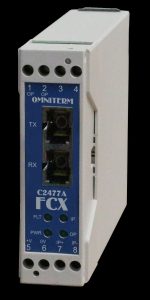
Telemetry tools are vital for monitoring the integrity of these systems, continuously checking operational conditions and identifying abnormalities. Real-time data transmission allows operators to respond quickly to faults before they escalate into more serious incidents. In the event of a broken wire or other infrastructure issue, sensors can trigger emergency protection systems to help safeguard railway assets, personnel and passengers.
Challenges of copper hardwiring
Traditional copper cabling remains widely used across railway infrastructure. However, over long distances it can be more susceptible than fibre optics to signal attenuation and electromagnetic interference (EMI), particularly in rail environments where high-speed traction currents are present.
If a critical signal is degraded or interrupted during transmission, this can create operational and safety risks. Maintaining signal integrity is therefore essential for emergency tripping and other safety-critical applications.
Copper transmission performance also depends heavily on cable type, signalling methods and environmental conditions. Longer-distance installations may require additional repeaters, amplifiers or interface equipment, increasing infrastructure complexity and maintenance requirements. Additional hardware can also increase inspection and servicing demands for rail engineers.
Supporting railway safety systems with fibre optics
Omniflex’s FCX bidirectional fibre optic module supports Train Protection and Warning Systems by enabling reliable long-distance signal transmission. The FCX combines transmission and reception capabilities within a single device, reducing the need for separate modules and simplifying installation.
In some applications, fibre optic cabling can also reduce lifecycle costs compared with copper, particularly over long distances or in environments with high EMI exposure.
Because fibre optics transmit data using pulses of light rather than electrical current, they are inherently immune to electromagnetic interference. Compatible with either 850 nm multimode or 1,310 nm single-mode fibre optic cabling, the latter can transmit switch contact signals over distances of up to 20 km, overcoming the long-distance signal transmission limitation associated with traditional copper cables.
The FCX bidirectional fibre optic module is certified for use in SIL-2 applications, a safety integrity level commonly associated with rail functions such as braking controls, door controls and passenger information systems. Its relay-based fault detection architecture is designed to support reliable remote emergency stop signal transmission in safety-critical environments.
To find out more about the FCX’s remote safety applications in the mining industry, visit Omniflex’s website: https://www.omniflex.com/product/C2477A
Read other recent instrumentation news: https://instrumentation.co.uk/category/news/